| ChinAfrica |
| Reclaiming the Riverbank |
| Jiujiang has turned derelict docks into a cultural park, showing that a river can serve people as well as factories |
| Zhang Xiao | VOL. 18 November 2026 ·2026-11-04 |
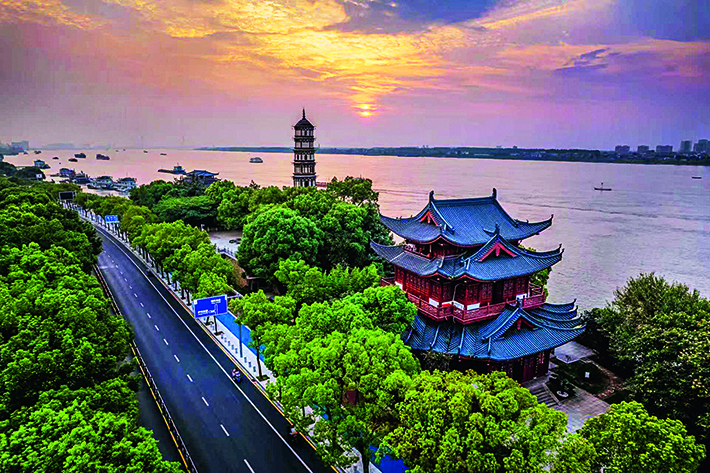
A view of Xunyang Tower and Suojiang Tower at sunset (COURTESY)
At the height of summer, the Jiujiang urban section of the Yangtze River National Cultural Park in Jiangxi Province, east China, is busy with visitors. From the fourth-floor observation platform of Pipa Pavilion, they can look out over the broad river, the Jiujiang Yangtze River Bridge and a skywalk that follows the embankment. Greenways link Pipa Pavilion, Xunyang Tower and Suojiang Tower, and the scene is one of calm water, historic rooftops and people strolling at their own pace.
This view would have been hard to imagine not long ago. Only a few years earlier, the area was a network of crowded docks and cluttered storage yards, and old industrial waterfronts had cut the city off from the river. Residents who lived beside the Yangtze often could not see it at all, as sheds, fences and the noise of cargo kept the bank out of reach.
Today the city and the Yangtze are reconnected, and the transformation has become a source of local pride. It shows what can happen when a city decides that its river is worth more as a place for people than as a site for industry.
From docks to promenades
In October 2023, President Xi Jinping stressed during an inspection tour that the Yangtze River Economic Belt can never be separated from the river’s nourishment. Jiujiang has responded with the approach of “jointly pursuing greater protection and avoiding excessive development.” The city remodelled its 10.9-km riverfront, phased out industrial docks, created ecological greenways and linked scattered historic sites. The former industrial rust belt has become an urban cultural corridor.
Pan Li, a Jiujiang native, remembers the Xunyang River bank more than a decade ago, when it was lined with freight docks, gravel yards and workshops. Old buildings blocked the view, and valuable waterfront land was occupied by low-efficiency industry. Local people often said the river felt like a distant neighbour, visible from the road but never within easy reach.
The clean-up was extensive. The city removed 74 illegal docks, shut down or relocated 37 chemical enterprises within one kilometre of the river and rehabilitated 876 sewage outfalls. Production facilities were cleared, wetlands and vegetation were restored, and three levels of pathways were joined into a continuous non-motorised route. Each change was designed to return the bank to people, not to the factories that had once crowded it.
Zhang Weiguang, Party secretary and general manager of Jiujiang Culture and Tourism Development Group, describes the park’s plan as “two routes and one park, with one belt and multiple nodes.” Pipa Pavilion sits at the centre of a cluster of three historic sites, several kilometres apart. The park has no walls and charges no admission, so residents can stroll the greenways and stop to admire the river wherever they like.
The renewal has reached the old Xunyang district too. Roads now link to the waterfront greenways, and vacant riverside plots have become pocket parks, reading rooms and squares. Residents of the Dazhong Road historic neighbourhood say an evening walk along the river has become part of their daily routine.
Heritage and sustainable development
The city has also brought its heritage back to life. Rather than fencing off historic sites and putting them on display, Jiujiang has carried out careful, small-scale renovations so that visitors can see, explore and engage with its landmarks.
Pipa Pavilion, made famous by Bai Juyi’s Song of a Pipa Player, was renovated without large-scale changes to the historic structure. Inside, an immersive digital exhibition uses holographic projection to recreate the scene of bidding farewell to a guest one night by the Xunyang River. An AI guide offers stories and allusions from classical poetry and the customs of the Tang Dynasty (618-907) Jiangzhou. Visitors often linger at the exhibition, reading the poem’s lines beside the very water that inspired it. Each night, the projection show Pipa Pavilion: Dreams of Xunyang brings the poem to life on the pavilion itself.
Xunyang Tower explores the culture of the classic novel Water Margin and the city’s history as a commercial port. Visitors can climb the tower, enjoy tea, listen to live storytelling and hear tales of the merchants who traded in Xunyang’s famous tea and rice markets. Suojiang Tower reflects Jiujiang’s heritage of flood control, with a digital exhibition that traces the history of river management. Together, the three buildings present poetry, commerce and river defence as one integrated story.
Protection rules are strict. Zhang explains that the guiding principle is “giving priority to protection while ensuring appropriate use.” Conservation plans are built into every development project, commercial activity must respect designated buffer zones, and renovations need approval from heritage authorities. Routine monitoring continues, and excessive commercialisation is prohibited.
The results are tangible. Since sections of the Xunyang River scenic area opened, it has received more than 6.2 million visitors, including over 2 million in 2025 alone. These figures show how quickly a revived waterfront can draw people back to a neighbourhood that had long been overlooked. Tourism has also lifted the restaurants, creative businesses and specialist shops of the Dazhong Road neighbourhood, and night cruises and light shows have boosted evening spending.
The park shows how ecological protection, heritage conservation and urban renewal can reinforce one another. Clear water draws visitors, and their presence helps fund further protection. Water quality in the Jiujiang section of the main stream has stayed at Class II for seven consecutive years, and finless porpoises can be seen leaping through the waves. Rather than sacrificing ecology for industry or exploiting relics for short-term gain, Jiujiang has turned the gains of river protection into cultural spaces. Local visitors often say the change is felt most in the evenings, when families, students and older residents share the same stretch of riverbank.
|
||
| About Us | Contact Us | Advertise with Us | Subscribe |
| Copyright Beijing Review All rights reserved 京ICP备08005356号-5 京公网安备110102005860号 |


