| ChinAfrica |
| Jewels of the Yangtze River |
| The return of the finless porpoise is a precious symbol of efforts to protect the river’s ecosystem |
| Zhao Yang | VOL. 18 November 2026 ·2026-11-04 |
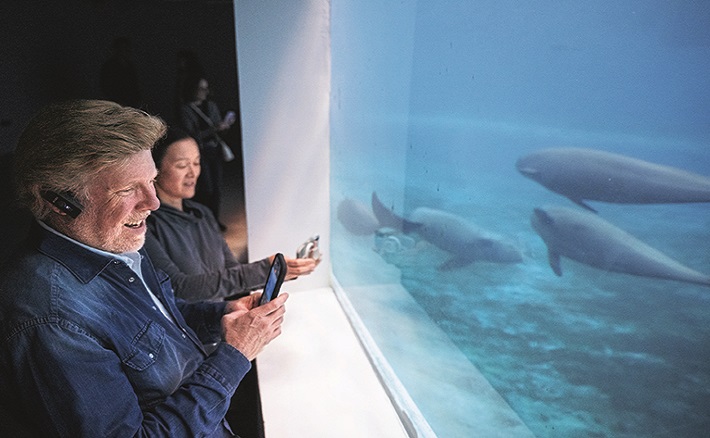
Foreign experts visit the Institute of Hydrobiology, Chinese Academy of Sciences, on 28 October 2025 (VCG)
Early spring held a crisp chill in Nanjing, Jiangsu Province, on 12 March. Getting off the train, Andrew Balmford, fellow of the Royal Society and professor of Conservation Science at the University of Cambridge, wasted no time in heading for the observation sites along the Yangtze River. A leading figure in global conservation biology, he made the trip specifically to see the Yangtze finless porpoise - a unique freshwater mammal found only in China and widely known as the “giant panda of the water.” His wait was brief. Within two minutes he had spotted eight porpoises moving through the clear shallows near the bank.
Balmford described the encounter as truly remarkable. One of the world’s rarest mammals was thriving in the middle of a busy metropolis of nearly 10 million people, surrounded by ships and buildings. For a conservation scientist, that combination is unusual, and it offers a model that other regions might study closely.
The porpoise’s return from the brink has not been easy. A decade ago, its population was falling by roughly 10 percent a year, and it had dwindled to around 1,000 animals. The International Union for Conservation of Nature classified it as critically endangered. The Yangtze River dolphin, another freshwater mammal native to the river, had already been declared functionally extinct. Water pollution, illegal fishing and shipping had pushed the finless porpoise to the edge, and its survival hung by a thread. Its recovery owes a great deal to scientists, volunteers, government agencies and local residents who refused to let it disappear.
Science and community
Much of that recovery began with Jiang Meng, the secretary general of the Nanjing Finless Porpoise Aquatic Life Protection Association. Jiang was working as a journalist when he became deeply concerned about the steep decline in the porpoise population. In 2015 he joined with like-minded peers, experts and volunteers to found the association. The early years were difficult. Public awareness of porpoise conservation was almost non-existent, and the association’s calls for action drew little response. Jiang came to see that the work needed far more science communication if it was to succeed.
A turning point arrived in 2016, when the national strategy to protect the Yangtze River began to take shape. The association gained growing support from the government, the media and the public. It expanded into a wide range of activities, including patrol-based rescue operations, science outreach and ecological restoration. The workload eventually became too heavy to manage alongside his journalism, and in 2022 Jiang made a career change and began working on conservation full-time.
The monitoring tools have improved dramatically over the same period. In the early days, scientists counted porpoises by hand, a method that was slow and often inaccurate. Passive acoustic monitoring came next, followed by active sonar systems that could be fitted to patrol vessels to identify and count porpoises in nearby waters. In 2022 environmental DNA technology made it possible to detect traces of shed skin and excreta in water samples. In 2025 drones were introduced for automatic tracking and early warning, and artificial intelligence now supports real-time data analysis, species identification and immediate alerts.
Volunteers have become just as important as the technology. Experts cannot be on duty along the river around the clock, and the association’s full-time staff cannot cover all the work alone. Local volunteers carry out daily monitoring and patrols, acting as mobile observers who support the researchers.

A science promotion event is held at the Nanjing Yangtze Finless Porpoise Monitoring Station on 19 February 2023 (CNS)
Recovery and challenges
The most significant change has been the decade-long fishing ban, which has given the Yangtze room to recover. By 2025 the porpoise population had risen from 1,012 to 1,426, a clear sign of renewed health. The animals now appear regularly in urban stretches of the river, which is a strong indicator of the improving ecosystem. Along the riverside in Nanjing, derelict docks, fishing boats and illegal anglers have largely disappeared. Clear water now reflects the sky, and the porpoises often swim as close as 10 metres from the bank, which shows how far the habitat has improved.
The porpoise has also become a bridge to the wider world. More than 300 international students from Belt and Road partner countries, as well as several European nations, have joined an international volunteer team. Each week they patrol the riverbank, clear rubbish and record field data. The association’s Yangtze Smile Relay Campaign, named after the porpoise’s naturally upturned mouth, has been included in projects under the Yangtze Culture Forum co-organised by UNESCO, and more than 50 international ambassadors and experts have been appointed Smile Ambassadors.

|
||||
| About Us | Contact Us | Advertise with Us | Subscribe |
| Copyright Beijing Review All rights reserved 京ICP备08005356号-5 京公网安备110102005860号 |


