| ChinAfrica |
| A Forest of Friendship |
| How a $5,000 gift to plant trees helped create a lush forest in the desert and forge a lifelong friendship |
| Ma Li | VOL. 18 November 2026 ·2026-11-04 |
When National Geographic journalists and participants of an international cultural exchange programme arrived at Yin Yuzhen’s forest in the heart of the Mu Us Desert in Inner Mongolia Autonomous Region in September, she was there to welcome them, and told them a story of how her forest started through her joint efforts with an American teacher. Just 10 days before that, she opened her door to her old American friend, Ronald Sakolsky.
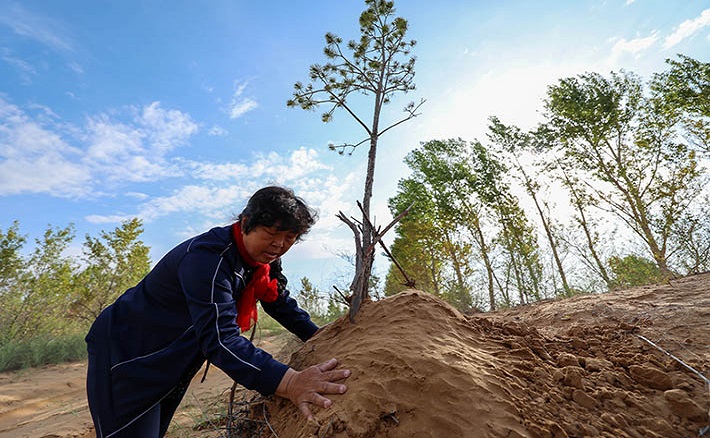
The story started 40 years ago, when this part of the desert was a barren expanse of sand where little could survive. Newly married, Yin had left Shaanxi Province to settle in a house half-buried in the dunes in Uxin Banner, Ordos, Inner Mongolia. The wind blew relentlessly. The isolation was so profound that she would cover the footprints of passers-by with a basin to protect them from disappearing, to create the illusion that people were around. To break this solitude, she began planting trees. Over the past 40 years, she has planted trees across more than 70,000 mu (about 4,667 hectares).
“This forest didn’t appear by chance. It’s the result of the perseverance of generations of pioneers like Yin,” explained Wu Dan, deputy director of the Publicity Department of the Communist Party of China Uxin Banner Committee. The combination of individual commitment and public support has made it possible to plant trees across 85 percent of the Mu Us Desert.
China’s approach to combating desertification is now recognised by the United Nations Environment Programme and other international institutions as a model for the world. Yin’s story is a powerful embodiment of this achievement.
A long-term pact
It all began in 1999. At the time, Ronald Sakolsky, an English teacher in Luoyang, Henan Province, saw Yin’s story in a television report. Struck by her determination, he spent two months raising $5,000 in the US. Although he doubted that trees could grow in sand, his primary aim was to support her perseverance.
Upon receiving the money, Yin had only one thing on her mind: buying the best seedlings. “By then, I already had some experience. The survival rate of the young trees reached 80 percent.” She invested every penny in high-quality seedlings, planting them one by one in the sand. Later, she erected a memorial stone bearing Sakolsky’s name in Chinese. “It wasn’t just to commemorate our friendship. It was a promise I made to myself: to nurture these trees so that one day he could come back and see them,” she recalled.
In 2000, Sakolsky visited the Mu Us Desert for the first time. Together, they planted a young poplar about a metre tall. When they had finished, he shook his head sceptically, “It won’t last.” Yin did not reply. From then on, she carried buckets of water across the dunes every day. By autumn, the poplar was still standing and thriving.
On 23 August, at the age of 76, Sakolsky returned to China at the invitation of the China Education Association for International Exchanges. Upon his arrival in Ordos, Yin was waiting for him. Over the following days, she showed him around the land he had once believed incapable of sustaining life.
On 24 August, he finally entered the forest that bears his name: the Sakolsky Forest. The poplar they had planted together, once a little sapling, now stands over 10 metres tall. In front of a new memorial stone, he drew a tree and then a heart, writing the letter “S” on one side and the name “YIN” on the other. Together, they planted another tree.
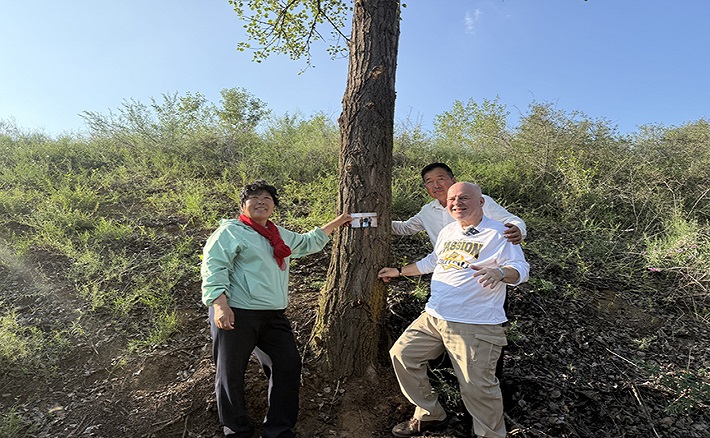
Yin Yuzhen (left) and Ronald Sakolsky (right, front) pose for a photo on 24 August in front of a tree they planted (COURTESY)
Linking two worlds
The story soon crossed borders, reaching the 17th session of the Conference of the Parties to the United Nations Convention to Combat Desertification, held in Ulaanbaatar, Mongolia. At the Chinese Pavilion, Andrea Meza Murillo, deputy executive secretary of the United Nations Convention to Combat Desertification, praised the effort. “The perseverance of one individual and international solidarity can accomplish immense things. Yin’s case is not isolated. It represents millions of Chinese people who, on their own initiative, are participating in reforestation and environmental protection.”
In Yin’s courtyard, young visitors from around the world find it hard to hide their emotions.
“She could have used that money to improve her own life, and no one would have blamed her. But she chose the harder path of planting trees,” said Lawrence Wang, an American student at Tsinghua University.
“Five thousand dollars is no small sum. She turned it into a forest. That’s the best use she could have made of it,” added Kylian Hamami, a French student.
For others, the story is a source of hope. Farid Mohamed Ahmed, who is from Egypt, said, “Desertification is a problem in my region, too. Seeing what has been achieved here makes me believe that, with the same techniques, we could transform our own deserts into places just as beautiful.”
As Sakolsky put it, “If a woman living in the Chinese desert and an ordinary American teacher could create a forest together, what could be impossible?”
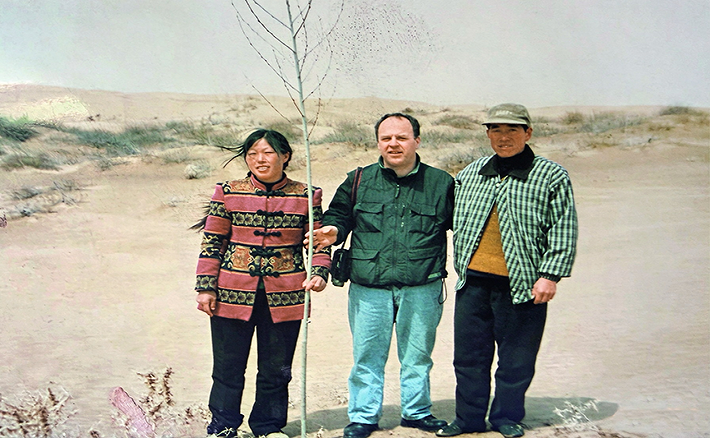
Yin Yuzhen and her husband pose for a photo with Ronald Sakolsky (centre) in front of a sapling they had planted in Uxin Banner, Ordos, Inner Mongolia, in 2000 (COURTESY)
The echo of the dunes
Today, the trees of the Mu Us Desert stretch as far as the eye can see. Yin still talks to the sand and the trees, but she no longer curses the wind. “I thank it; it helped these trees grow so well!” In the forest, she touches one trunk and pats another. “They are like my children. They surround me and laugh.”
In Yin’s family, everything is about trees; even her children’s names are related to the forest. For future generations, she has a simple wish: to combine technology with nature so that farmland, forests and pastures can all thrive.
Back in the US, Sakolsky is already thinking about how to expand exchanges. “Without teacher exchange programmes, I would never have come to China. To improve relations between the two countries, we must start with children and students.” Yin, for her part, will continue sharing her story to encourage others to plant trees and transform sand into fertile soil.
|
||||||||||||
| About Us | Contact Us | Advertise with Us | Subscribe |
| Copyright Beijing Review All rights reserved 京ICP备08005356号-5 京公网安备110102005860号 |


