| ChinAfrica |
| Making Waves on Lake Malawi |
| Chinese company collaborates with Malawian government to upgrade Lake Malawi water transport facilities |
| Edwin Nyirongo | VOL. 18 November 2026 ·2026-11-04 |
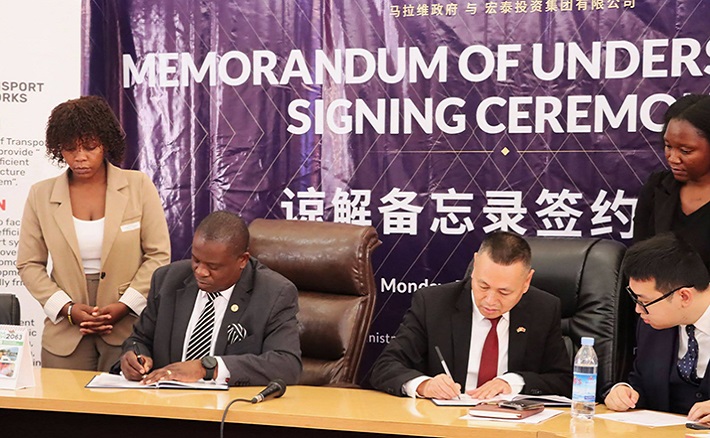
Signing ceremony of the memorandum of understanding (MINISTRY OF TRANSPORT AND PUBLIC WORKS OF MALAWI)
With Lake Malawi covering about a quarter of the country, water transport is one of the most important modes of transport in the small southeast African country.
However, the poor quality of this transport system has long been hampering both people and cargo movement on the enormous lake, the third-largest lake in Africa by surface area. Malawi has three main passenger ships - Ilala, Mtendere and Chauncy Maples. These vessels rarely travel for a year without being grounded for maintenance and are often out of action at the same time, affecting transport between the two islands on the lake of Likoma Island and Chizumulu Island, and the mainland.
Residents on the islands rely solely on water transport for their survival. Likoma, for example, has a secondary school, a hospital and a military camp, whose personnel depend on water transport for vital mainland supplies.
Now, to alleviate this major challenge, Chinese company Hongtai Investment Group is set to invest $20 million in Malawi’s water transport by supplying a new cargo vessel and passenger vessel, as well as modernising the Monkey Bay Shipyard. This is according to a memorandum of understanding (MoU) the company signed on 7 September with the Malawian government.
Currently, Ilala is the only vessel in operation. Built in 1949, and beginning service in 1951, it has a capacity of 400 passengers but is woefully outdated. Mtendere was built in 1979 and launched in 1980, with a capacity of 420 passengers and 50 tons of cargo. But in the 2010s, Mtendere was taken out of service after developing extensive mechanical problems, needing a total overhaul. Chauncy Maples, the oldest and smallest of the three, was built in 1899 and due to costs, many attempts at its restoration have been abandoned.
A lifeline under strain
Emily Mabuka set up her fish-selling business on the mainland about five years ago. She buys fish from the islands. Transport challenges have caused her endless hardship.
“My business mostly depends on time and schedule. But because of transport problems, things do not always work as you plan,” she said.
She recalls an incident where she received a lucrative order for Chambo fish - a popular food enjoyed by both local Malawians and tourists - from a businessperson on the mainland. The only place she could find Chambo was Likoma Island.
After making her purchase and drying the fish, she waited for the vessel Ilala to return the following day. It did not.
“I was then told that Ilala had developed a fault and had gone for maintenance. I lost the major deal as there was no other water transport alternative back to the mainland.”
According to Mabuka, small local island boats are not equipped to cross the bay to the mainland as they cannot cope with the strong waves.
“It wouldn’t be a problem if small boats were operating between Likoma and Nkhata Bay. But it’s too dangerous because it is far. As a result, we depend on unreliable water transport we currently have,” she said.
The investment in water transport is therefore a welcome development, not only for businesspeople, but also residents of Likoma and Chizumulu islands.
A new course for lake transport
Speaking during the MoU signing ceremony, Hongtai Investment Group Managing Director Shan Jianping said his company is committed and determined to help Malawi break through the bottlenecks in lake transport and revitalise its economic momentum in line with the Malawi National Transport Master Plan and Malawi 2063.
Shan said although Malawi is landlocked, lake transport serves as a crucial link connecting the country to the Southern African market, opening up external channels and unleashing its developmental potential.
“We firmly believe that accurately aligning our own advantage with Malawi’s development needs is not only a corporate responsibility, but also an inevitable choice for mutual benefit and win-win results,” said Shan.
The company plans to modernise Monkey Bay Shipyard and then collaborate with Malawi Lake Services to build new modern cargo vessels and new modern ports in Chipoka and elsewhere.
“The Hongtai Investment Group also seeks to address the shortcomings and strengthen the foundation of Malawi’s lake transport infrastructure, upgrade port loading and unloading equipment, improve warehousing and logistics systems, and optimise the transport route network. We will strive to create an efficient, safe and convenient modern lake transport hub, fundamentally enhancing the carrying capacity and operational efficiency of Malawi’s lake transport and laying a solid foundation for Malawi’s import and export of goods,” said Shan.
He described the signing ceremony as not only the formal beginning of cooperation between the Hongtai Investment Group and the Malawi government, but also a crucial step for both sides to jointly solve the challenges of lake transport development and jointly draw up a blueprint for development.
Bright Kumwembe, principal secretary for the Ministry of Transport and Public Works, welcomed the investment and said Malawi is committed to promoting growth through strategic infrastructure investment and constructive partnerships with the private sector and development partners.
He said efficient and reliable transport services are essential for facilitating trade, promoting tourism, strengthening regional integration and supporting the movement of people and goods.
“Malawi’s inland water transport sector holds considerable potential to contribute to national development. Lake Malawi is an important national asset, and its full potential can be realised through investment, innovation, modernisation and partnerships that improve the safety, reliability, accessibility and efficiency of water transport services,” said Kumwembe.
| About Us | Contact Us | Advertise with Us | Subscribe |
| Copyright Beijing Review All rights reserved 京ICP备08005356号-5 京公网安备110102005860号 |


