| ChinAfrica |
| Beyond the Headlines |
| Kenyan journalists explore the people, ideas and experiences behind China’s development |
| By Hu Fan | VOL. 18 November 2026 ·2026-11-05 |
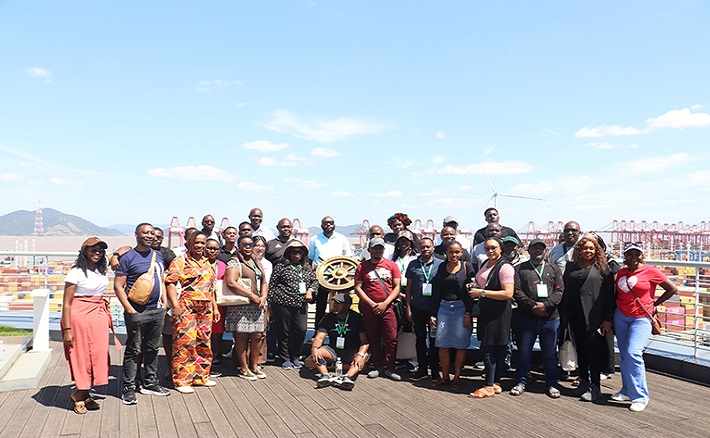
Kenyan media professionals pose for a group photo at Ningbo-Zhoushan Port in Zhejiang Province on 15 September (Hu Fan)
For journalists, reading about a country is not the same as experiencing it firsthand. Headlines can convey the scale of economic growth, infrastructure projects and technological advances, but understanding how these developments came about requires looking more closely at the people, history and ideas behind them.
That was the opportunity offered to around 30 Kenyan media professionals during a two-week workshop in China, which included visits to Ningbo and Jiaxing in Zhejiang Province. From a major port and a rural community to historic sites associated with the founding of the Communist Party of China (CPC), the delegation explored different aspects of the country’s development.
For Samuel Mwanawanjuguna, lead editor at the Kenyan news website Kenyans.co.ke, the experience helped turn what he had read about China into something more tangible. “There’s a difference between knowing a story, and being close enough to interrogate one,” he said.
Before the visit, Mwanawanjuguna had read extensively about China’s economic growth, infrastructure and technological progress. Travelling through the country, however, helped him connect these subjects and understand them in context. The visits also prompted him to reconsider how China is covered in African newsrooms, where the country is often presented through the actions of its government rather than the experiences of ordinary people.
Seeing development firsthand
At Ningbo-Zhoushan Port, the Kenyan journalists saw how technology and modern infrastructure support large-scale economic activity. As one of the world’s major container ports, it offered a practical view of how digital systems are integrated into port operations.
For Mwanawanjuguna, the visit had direct relevance to Kenya, where ports are handling growing container volumes. Observing Ningbo’s operations gave him a more concrete basis for exploring how technology might improve efficiency and support the development of Kenya’s own logistics capabilities.
Rather than discussing port development only in general terms, he could now ask more specific questions about operational practices, technological solutions and potential avenues for cooperation. The experience also reinforced the importance of examining how a particular approach works and whether it suits another country’s circumstances, rather than simply replicating it.
At Tengtou Village in Ningbo, the delegation encountered a different dimension of development: how economic activity can be combined with environmental protection and improvements in residents’ lives.
Known for its efforts to integrate industrial development, modern agriculture, tourism and ecological conservation, Tengtou attracted international attention when it was presented at the 2010 Shanghai World Expo. But it is more than a destination for visitors. It is a functioning community with businesses, collective economic activity and public welfare programmes.
For Nimrod Taabu, an anchor, reporter and producer at Kenya’s Royal Media Services, the visit was an eye-opener. He was impressed by the greenery and waterways, but also by the sense of community and shared responsibility.
“The leadership has ensured that people come together to help one another, to become one community,” he said.
Taabu was particularly interested in how young people could contribute to economic growth while continuing to live and work in a village. Tengtou challenged the assumption that modern employment and development opportunities must be concentrated in major cities, showing how rural communities can build economic activity while seeking to protect their surroundings and improve living standards.
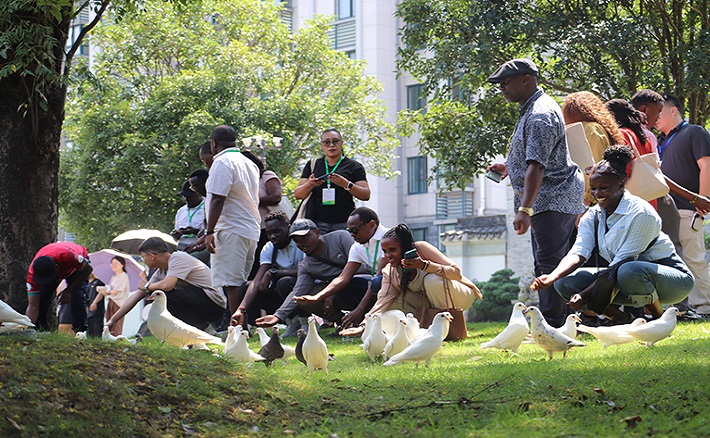
Kenyan media professionals feed pigeons at Tengtou Village in Ningbo, Zhejiang Province, on 14 September (Hu Fan)
Finding the roots of development
Beyond the visible results of development, the visits also prompted the journalists to consider the ideas, historical experiences and aspirations that have shaped China’s development.
At the Former Residence of Wang Yangming in Ningbo, the delegation considered how ideas can translate into action. Regarded as one of China’s most influential philosophers, Wang was a scholar, government official and military general in the Ming Dynasty (1368-1644) whose thought continues to resonate in China today. He is particularly associated with zhixing heyi, commonly translated as the unity of knowing and acting. The principle holds that genuine understanding should be reflected in practice rather than remain an abstract intellectual exercise.
Aggrey Mutambo, editor at Kenyan newspaper The Nation, found this idea particularly relevant to social development. “When you learn something, you have to implement something,” he said. “And that principle of action is what determines how the society is developed.”
For Mutambo, Wang’s philosophy offered a way to understand China’s approach to development: putting learning into practice.
The importance of history and purpose came into focus again in Jiaxing, where the delegation visited Nanhu Lake, the site where the CPC’s First National Congress concluded in 1921, and a memorial hall dedicated to the Party’s history. The Red Boat associated with the congress has since become a symbol of the Party’s founding aspirations and original mission.
For Mwanawanjuguna, the visit highlighted the importance China attaches to its origins. He was struck by the emphasis on remembering the CPC’s beginnings and remaining true to its aspirations.
Mutambo, meanwhile, reflected on China’s ability to learn from other countries without simply copying their models.
“Development is a journey, but each country must identify its destiny,” he said.
For him, China’s experience offered lessons to consider rather than a template for other countries to reproduce. Understanding a different civilisation, he added, requires listening to its people and visiting the places where they live.
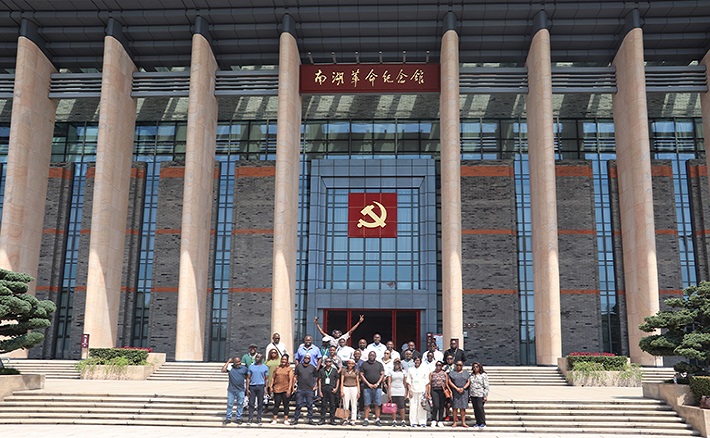
Kenyan media professionals pose for a group photo at the Nanhu Revolutionary Memorial Hall in Jiaxing, Zhejiang Province, on 19 September (Hu Fan)
From observation to better reporting
For the visiting journalists, the significance of the workshop extended beyond the sites they visited. It also prompted them to reflect on the role of the media in fostering mutual understanding between China and Africa.
Mwanawanjuguna argued that coverage of China-Africa relations should move beyond the familiar cycle of summits, agreements, loans, infrastructure projects and official visits. While these developments matter, he said, they tell only part of the story. Journalists also need to explore what trade, investment, technology and cooperation mean for ordinary people.
He called for more two-way reporting, with African journalists spending time in Chinese communities and Chinese journalists reporting more extensively from African communities, including places beyond national capitals and official institutions.
Mutambo likewise advocated creating more channels for direct exchange and reducing the number of intermediaries involved in communication.
| About Us | Contact Us | Advertise with Us | Subscribe |
| Copyright Beijing Review All rights reserved 京ICP备08005356号-5 京公网安备110102005860号 |


