| ChinAfrica |
| A Boat That Made History |
| A visit to Jiaxing’s Red Boat offers a glimpse into the humble beginnings of the Communist Party of China and its enduring spirit |
| By Nancy Agutu | VOL. 18 November 2026 ·2026-11-06 |
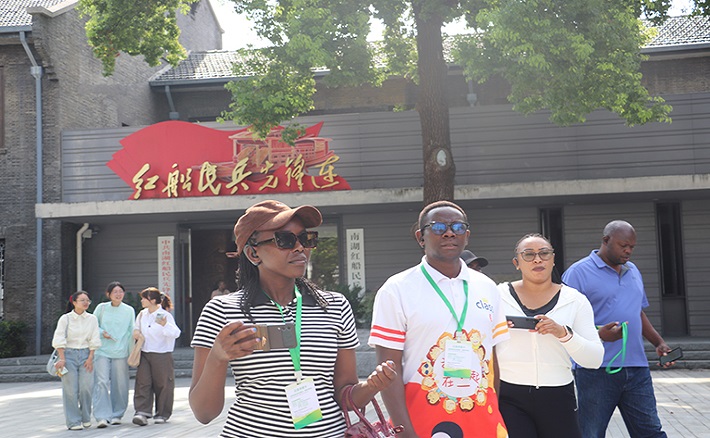
Nancy Agutu (left) during a visit to Nanhu Lake in Jiaxing, Zhejiang Province, on 19 September (Hu Fan)
As the morning sun peered through my white curtains in Jiaxing, Zhejiang Province, I woke up eager to see the Red Boat that has been spoken about so much in China’s development.
As we left our hotel, eagerness filled the coach. The feeling that this boat would indeed be extremely red started to fill my thoughts.
“We must see this red boat and take pictures,” a colleague seated beside me said. We imagined something grand, something painted entirely in revolutionary red.
As we arrived at our destination, the enchanting beauty of the southern Yangtze region unfolded before us. Nanhu Lake was still and wide, willow trees drooping low over stone bridges, the air humid and soft. Some local residents sat under the trees, enjoying the fresh air. In the distance, beside the central island, the Red Boat was moored.
It was not extremely red.
It was made of dark wood, almost black from years of exposure to the lake and the sun. Its low, flat front deck was where the boatman would have stood. Two black bollards and fading gold carvings along the roof completed its understated appearance.
“The little lattice windows along the side – that’s where 13 people sat, shoulder to shoulder, pretending to drink tea and play mahjong while they were actually writing a Party programme,” our English translator said as she gestured towards the boat.
We stared closely, wondering how something so small could make history. Behind it, the modern Jiaxing skyline rose above the old wooden hull, with high-rises emerging through the haze. Old and new China stood together in one frame.
And yet, as President Xi Jinping said when he stood here in 2017, this small boat “sparked the flame of the Chinese revolution and started the century-spanning voyage of the Party.”

Kenyan media professionals learn about the Red Boat at Nanhu Lake in Jiaxing, Zhejiang Province, on 19 September (Hu Fan)
A humble boat, a historic meeting
In July 1921, 13 young delegates were forced to abandon their meeting in Shanghai after French police raided the house in the French Concession. It was Wang Huiwu, a 23-year-old woman from Jiaxing, the wife of delegate Li Da, who said: “Come to my hometown. It’s quiet there.”
They took the train to Jiaxing Railway Station, walked to Shizihui Ferry and boarded the boat, pretending to be tourists. While the delegates whispered and wrote inside, Wang sat on the bank with her baby, keeping watch.
For seven hours, on a boat meant for mahjong and wine, not revolutions, they held the meeting that would lead to the founding of the Communist Party of China (CPC).
The boat you saw today is a replica dating from 1959. The original was lost during the war years. However, we consulted people familiar with its history, who helped us recreate the design,” our guide Avril said.
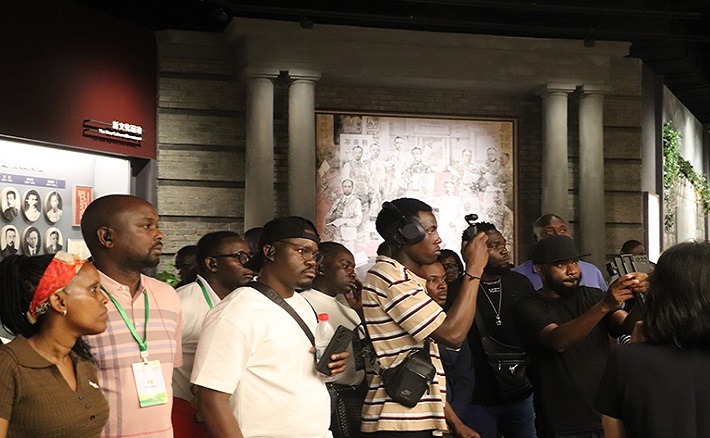
Kenyan media professionals visit the Nanhu Revolutionary Memorial Hall in Jiaxing, Zhejiang Province, on 19 September (Hu Fan)
The spirit behind the symbolism
The meaning became clearer when Kenya Editors Guild CEO Linda Bach shared her reflections on Xi Jinping: The Governance of China, Volume V.
“Before reading this book, I had never heard about the Red Boat spirit. Today, however, I know about this symbolism, its origin and its core values,” she said.
She explained its three pillars: the pioneering spirit of daring to be first; the struggling spirit of remaining steadfast through adversity; and the dedication spirit of serving the people wholeheartedly.
Coming from Kenya, where there are around 100 registered parties, many of which Kenyans call “briefcase parties” that exist only on paper, Bach said the contrast was striking: “In China I see unity and loyalty that has birthed serious development.”
She noted two lessons she took from President Xi’s book: upholding centralised, unified leadership and living up to people’s expectations. Quoting President Xi, she said if a large party cannot enforce unified leadership, different localities and departments will go their own way and nothing will be accomplished.
And on governance, she added, “If my country Kenya could borrow this philosophy that ‘lucid waters and lush mountains are invaluable assets’, the Nairobi River could have still and fresh waters supporting plants and humans.”
|
||
| About Us | Contact Us | Advertise with Us | Subscribe |
| Copyright Beijing Review All rights reserved 京ICP备08005356号-5 京公网安备110102005860号 |


