| ChinAfrica |
| Breeding a Better Harvest |
| For the past 30 years, China’s high-yielding rice varieties have helped strengthen the country’s food security |
| By Ge Lijun | VOL. 18 November 2026 ·2026-11-06 |
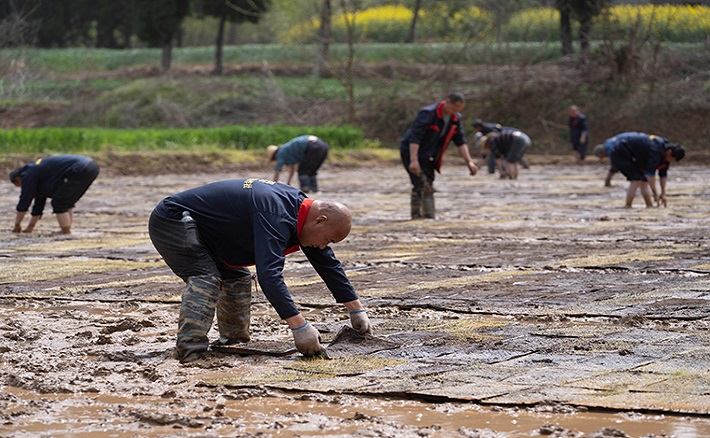
In autumn, rice fields in Liaozhong District, Shenyang, Liaoning Province in northeastern China, are laden with heavy, well-filled panicles. Despite their abundance, the stalks remain straight and sturdy. This high-yielding rice, known as super rice, with its upright panicles, illustrates the progress made in Chinese plant breeding. Located in the “golden rice belt”, Liaoning benefits from natural conditions favourable to rice cultivation and ranks among China’s 13 leading grain-producing regions.
Thirty years ago, China launched a major breeding programme to increase rice yields and strengthen food security. In 1996, 11 research organisations pooled their expertise in Shenyang to develop high-yielding varieties that also offered good flavour and greater resistance to diseases and environmental stresses. This marked the beginning of China’s super rice breeding programme.
In the 1990s, the average rice yield in China barely exceeded 400 kg per mu (0.07 hectares). Increasing production was therefore essential to meeting the food needs of the population. According to Chen Wenfu, an expert with the Chinese Academy of Engineering, the programme brought together specialists in genetics, crop production techniques, plant protection and agricultural extension.
As early as 1997, Chen’s team at Shenyang Agricultural University developed a variety with large, upright panicles, known as Shennong 265. In demonstration plots, its yield exceeded 800 kg per mu. This breakthrough strengthened China’s seed self-sufficiency. Subsequently, more than 20 varieties adapted to different rice-growing regions were introduced, reducing dependence on Japanese seeds.
Today, 129 varieties have been officially recognised as high-yielding by China’s Ministry of Agriculture and Rural Affairs. Cultivated across more than 130 million mu (8.67 million hectares), they account for nearly 30 percent of the country’s rice-growing area. Their contribution has been significant: the national average yield rose from 388.6 kg per mu in 1991-1995 to 475.9 kg in 2021-2025, an increase of 22.5 percent.
|
||||||||||||
| About Us | Contact Us | Advertise with Us | Subscribe |
| Copyright Beijing Review All rights reserved 京ICP备08005356号-5 京公网安备110102005860号 |


