|
||||||||||
| Home Top News Economy/Tech Culture/Sports China in Foreign Eyes Green Development Videos Intangible Cultural Heritages |
|
||||||||||
| Home Top News Economy/Tech Culture/Sports China in Foreign Eyes Green Development Videos Intangible Cultural Heritages |
| Current Cover Story |
| A Strategic Shift |
| Two Sessions reaffirm China’s commitment to high-quality development and global opportunities |
| By Hu Fan | VOL. 18 April 2026 ·2026-03-30 |
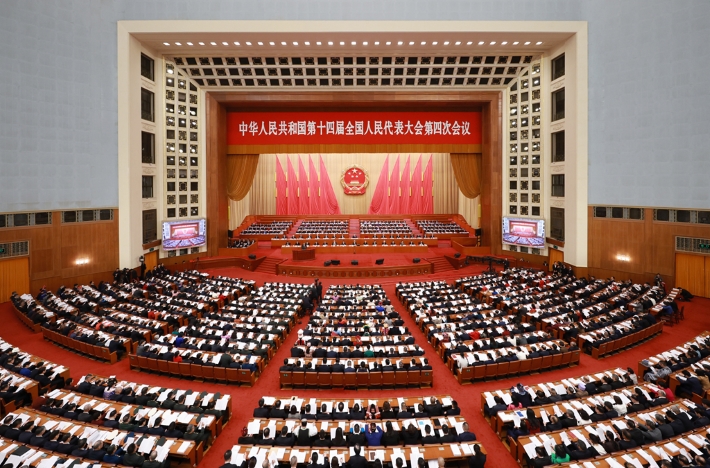
The closing meeting of the fourth session of the 14th National People’s Congress is held at the Great Hall of the People in Beijing, capital of China, on 12 March (XINHUA)
At the start of China’s 15th Five-Year Plan period (2026–2030), signals from March’s Two Sessions point to a subtle but notable change in direction. Policymakers are moving beyond an emphasis on headline growth figures and are instead concentrating on building a more resilient economic foundation in a volatile global environment.
One of the clearest signals is a recalibration of priorities. A GDP growth target of around 4.5 to 5 percent for 2026 suggests that while growth rate remains important, it is no longer the sole measure of success. Increasingly, the focus is shifting towards improving the quality, resilience and sustainability of development.
Beyond speed
At the heart of this transition is a renewed focus on domestic demand. Against a backdrop of geopolitical tensions and rising protectionism, strengthening the internal market has become both an economic necessity and a strategic priority. China’s Government Work Report places the expansion of domestic demand at the top of this year’s policy agenda.
This priority is reflected in a series of concrete measures. The consumer goods trade-in programme will be sustained, supported by 250 billion yuan ($36.3 billion) in ultra-long-term special treasury bonds this year. To date, it has driven sales exceeding 4.16 trillion yuan ($604.1 billion) and reached more than 531 million consumers. At the same time, steps are being taken to boost service consumption and tap into demand in lower-tier markets.
Another key pillar is technological innovation. The idea of “new quality productive forces” is gaining traction, supported by continued investment in science and technology. China is developing new drivers of growth across six strategic industries: integrated circuits, aerospace, biomedicine, low-altitude economy, new energy storage and intelligent robotics. Their combined output is estimated to have neared 6 trillion yuan ($871.3 billion) in 2025 and is expected to surpass 10 trillion yuan ($1.5 trillion) by 2030.
Meanwhile, China is expanding support for future-oriented industries such as quantum technology, bio-manufacturing and brain-computer interfaces. While breakthroughs are yet to come, these sectors are widely seen as having the potential to develop into important engines of future growth.
In terms of opening its market to the world, China has reaffirmed its commitment to easing market access, improving the environment for foreign investment and deepening trade and investment cooperation. Key priorities include expanding opening in the services sector, shortening the negative list for foreign investment and developing platforms such as free trade zones and the Hainan Free Trade Port.
At the same time, China intends to raise the quality and balance of trade by encouraging imports, developing policies for cross-border services and new trade models, and continuing to hold major international expos. Efforts will also be directed towards increasing two-way investment through national treatment for foreign enterprises, improved investment services, and support for Chinese companies engaging in global cooperation.
The Two Sessions also emphasised social development alongside economic policy. Among the 20 target indicators in the 15th Five-Year Plan, seven are dedicated to people’s livelihoods, covering employment, income growth and health care. The plan notably sets a target life expectancy of 80 years, matching the levels seen in high-income nations.
Green development is another priority. The Government Work Report calls for coordinated action to reduce carbon emissions, curb pollution, expand green development and maintain growth, in line with China’s carbon peaking and carbon neutrality objectives. Key areas of focus include accelerating the move to cleaner energy, promoting greener industrial practices, and encouraging more efficient, resource-saving production and consumption, including circular economy initiatives and low-carbon lifestyles.
Of particular note is the Ecological and Environmental Code, which marks an important milestone. It is China’s second formal statutory code after the Civil Code of 2020 and the world’s first comprehensive legal framework dedicated to ecological and environmental protection, signalling a new phase in environmental governance.
Message to the world
For partners around the world, including in Africa, these policy directions carry significant implications. A more innovation-driven and consumption-oriented Chinese economy, opening further to the world, is expected to generate new opportunities for trade, investment and industrial cooperation.
In particular, China will implement a zero-tariff policy covering 100 percent of tariff lines for products from African countries that maintain diplomatic relations with China, starting in May. This initiative is expected to greatly expand market access for African exports. By taking advantage of these opportunities, African countries can accelerate industrial transformation, diversify their export structures and advance industrialisation.
At a time of growing global uncertainty, China continues to position itself as a source of stability and openness. Over the past five years, the Chinese economy has recorded an average annual growth rate of 5.4 percent, contributing around 30 percent to global economic growth. Observers note that China’s policy consistency, pragmatic approach and relative predictability are helping to provide confidence and momentum for the global economy.
In this context, this year’s Two Sessions go beyond setting targets for the year ahead. They reflect how China is navigating both domestic and global challenges while advancing high-quality development, and contributing to a world in need of stability, growth and confidence.
| About Us | Contact Us | Advertise with Us | Subscribe |
| Copyright Beijing Review All rights reserved 京ICP备08005356号-5 京公网安备110102005860号 |


