| ChinAfrica |
| China’s Digital Development |
| Technology is transforming China’s economy, governance and quality of life |
| By Arassy ep Razafindratovolahy Sarah | VOL. 17 December 2025 ·2025-12-01 |

Arassy ep Razafindratovolahy Sarah at the Chengdu Science Fiction Museum in Sichuan Province
What fascinates me most about China’s digital development is how deeply it has transformed the economy, not only in cities, but across farms, factories, and daily life. Digitalisation here is not a privilege of the elite but a nationwide strategy applied to the primary, secondary, and tertiary sectors with purpose and precision.
In agriculture, digital tools are strengthening China’s food security. Drones monitor crops, sensors measure soil conditions, and farmers use smartphones for weather forecasts, pest control, and real-time market prices. Artificial intelligence and big data help local authorities to forecast yields, reduce waste, and balance pricing to benefit both producers and consumers. Through e-commerce platforms such as Taobao, even elderly farmers in remote villages can livestream and sell produce directly to urban buyers, increasing income and advancing the goal of national food self-sufficiency.
In the industrial sector, digital transformation is equally profound. At the 27th China Beijing International High-Tech Expo held in May, I witnessed breakthroughs in intelligent manufacturing, information technology, and health care innovation. These reflect China’s “Made in China 2025” strategy, which aims to bring a shift from labour-intensive production to high-value industries such as electric vehicles, aerospace, and semiconductors.
Companies like Huawei and Xiaomi are not only market leaders but digital innovators, building 5G infrastructure and AI-enabled ecosystems that support smaller enterprises and fuel international competition. This progress is actively supported by government through tax incentives, research funding, and coordinated infrastructure planning, which ensure that technological growth serves the nation’s long-term strategic goals.
In the tertiary sector, digitalisation touches every aspect of life. I rarely use cash in China - nearly every transaction, from paying utility bills to taking public transport, could be done via Alipay or WeChat Pay.
Ultimately, China’s digital transformation is not just about economic modernisation but about improving the quality of life. It shows how technology can drive inclusive development, ensuring that no part of the economy or society is left behind. And this transformation is creating value far beyond China’s borders. In my home country, Madagascar, I know small business owners who use Alibaba and Temu to do business.
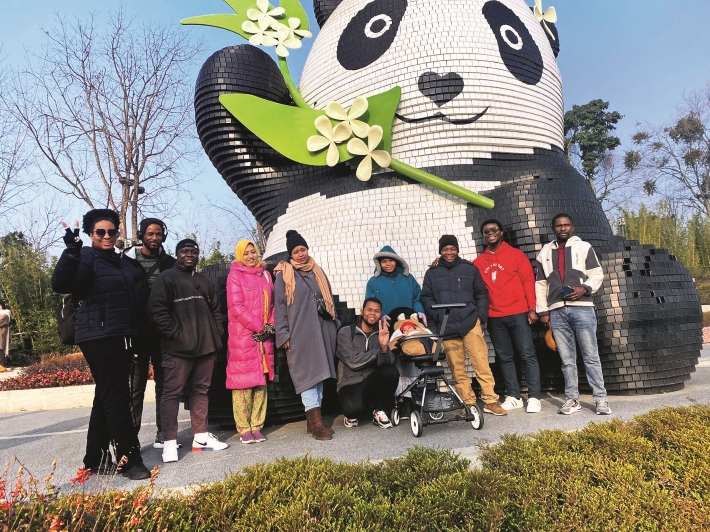
Arassy ep Razafindratovolahy Sarah (fourth right) with friends during a visit to the Chengdu Research Base of Giant Panda Breeding in Sichuan Province
AI and human resource management
One of my most intellectually stimulating experiences in China was a lecture by Professor Pan Na on AI-enabled human resource management in the public sector. She described a pilot project launched in October 2024 in Futian District, Shenzhen, where artificial intelligence was applied to public service delivery and internal management.
The initiative involved 70 employees across 11 departments supported by “robot recruiters,” “robot civil servants,” and “AI trainers.” These systems handled real administrative tasks, such as pre-screening applicants, scheduling interviews, processing documents and personalising staff training. Rather than replacing human workers, AI reduced repetitive tasks, enabling officials to focus on policy design and human-centred decision-making. This approach enhances efficiency, fairness, and innovation while reducing bureaucratic bottlenecks.
Reflecting on Madagascar’s limited and uneven public workforce, I realised how similar AI tools could improve service delivery, streamline recruitment, and extend administrative capacity to remote areas, enhancing governance without diminishing human value. China’s experience shows that digital transformation begins with people, not platforms.
Public services
My own experience extending my residence permit in China revealed the power of e-government in practice. I expected a long bureaucratic process but found it remarkably efficient. Most steps - from form-filling to document uploads - were completed online, with confirmation arriving within days. Only final verification required a short in-person visit, where digital systems ensured accuracy and speed.
China’s e-government strategy integrates government-to-citizen, government-to-business, and government-to-government systems through unified digital platforms. Citizens can register births, renew ID cards, pay fines, or book medical appointments via apps or self-service kiosks. In rural areas, mobile service vans and digital booths bring these conveniences to remote communities.
In education and health care, digital tools now allow patients to book hospital visits and teachers in rural schools to access online resources, narrowing regional gaps.
These changes come from better system integration, not from replacing people. Public officers still play a key role, supported by tools that make their work faster and more efficient. In this way, China’s e-government doesn’t remove bureaucracy - it modernises it to keep pace with a digital society.
Environmental innovation
Another striking dimension of China’s digital transformation is its alignment of technology with environmental protection. In many countries, ecology and innovation often appear at odds; in China, they advance together.
A major example is Ant Forest, an Alipay initiative that rewards eco-friendly behaviour, such as walking instead of driving or using digital payments, with “green energy points.” These points fund real tree planting in arid regions. Participating in this programme gave me a sense that even small personal choices contribute to collective environmental progress.
In Shenzhen, I witnessed AI-powered recycling bins that automatically sort waste and reward proper disposal. Public transportation is now largely electric, and real-time data systems manage traffic to reduce emissions. Smart grids and widespread charging stations further promote sustainable energy use.
At the industrial level, China is making great progress in carbon capture, renewable energy, and emissions monitoring. Projects like Sinopec’s carbon capture plants illustrate how heavy industries can transition to greener models. As a global leader in solar and wind power, China also employs AI to optimise energy distribution and storage.
These examples prove that digital transformation and ecological responsibility are not opposing goals. China’s experience shows how technology, when guided by purpose, can serve both progress and the planet.
The author is Master’s Student from University of Electronic Science and Technology of China
|
||||||||||||
| About Us | Contact Us | Advertise with Us | Subscribe |
| Copyright Beijing Review All rights reserved 京ICP备08005356号-5 京公网安备110102005860号 |


