| ChinAfrica |
| Walking East: Kenya-China Partnership Drives Change |
| China’s development experience shows that with persistence and coordinated strategies, developing countries can significantly reduce poverty through international cooperation, investment, technology transfer, infrastructure and capacity building |
| By Beatrice Elachi Kadeveresia | Web Exclusive ·2025-12-05 |
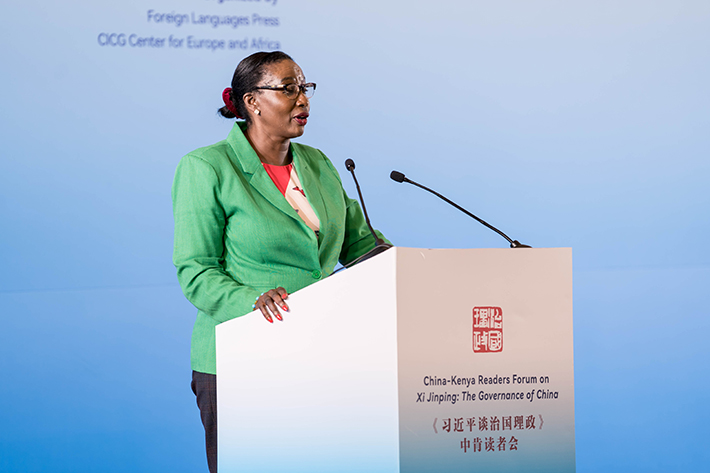
Beatrice Elachi Kadeveresia, a member of Kenya’s National Assembly and secretary general of the Kenya-China Friendship Association, speaks at the China-Kenya Readers Forum on Xi Jinping: The Governance of China held in Nairobi, Kenya, on 3 December
The perspectives presented in Xi Jinping: The Governance of China offer important insights that bear direct relevance to Kenya’s own policy direction. It is important to acknowledge the milestones we have achieved as a country by embracing China as a key partner in our development journey within the global landscape.
When we look at China today, it is important, especially for young people, to understand that China has historically achieved poverty reduction on a scale unmatched by any other country. This is why, during his tenure, the late President Mwai Kibaki believed that if Kenya aspired to transform itself, it needed to look east.
This marked the beginning of our engagement and the launch of Vision 2030. Vision 2030 is designed to drive growth for our country, and I believe we drew heavily from China’s development model. It aims to elevate Kenya to a middle-income country, providing a high quality of life to all citizens by 2030.
However, for Kenya to achieve this, we need to re-examine some of our priorities, beginning with the agricultural sector. Agriculture remains central to our goals. Today, when we see what President William Ruto is doing - abolishing burdensome agricultural taxes and empowering farmers through affordable fertiliser, improved seeds, irrigation, research, and extension services, we understand that these measures are essential for improving national yields.
A second goal is to industrialise Kenya, stimulate economic growth, promote urbanisation, and create jobs. Here, China offers valuable lessons. Its leadership in global trade and foreign investment is rooted in strong infrastructure development. Kenya must likewise continue investing in connectivity: roads, electricity, rural electrification, water systems, and transport networks. These are especially critical for rural and remote areas and enable better service delivery, trade, market access, and mobility.
As we consider our place in the Global South, where China is now a leading actor, we must also strengthen our social policy framework. Effective poverty reduction requires targeted safety nets that identify the poorest households, understand their needs, and channel resources efficiently. Promoting economic diversification and creating jobs beyond agriculture is another essential national priority.
As we advance our partnership with China, we must ensure a mutual commitment to strengthening the capacity of young people. Like China, we must reinvest in TVET (Technical and Vocational Education and Training) so that our youth acquire the skills necessary not only for trade with China but also for value addition at home.
Kenya has abundant raw materials, but we must encourage China to support us in localising industries within Kenya. This will build the skills and capacity of our young people and create jobs, replicating what China has successfully achieved. When I visit China today, I see one-stop light industries thriving even in remote regions. This is exactly what Kenya needs.
For our relationship to remain strong, balanced and rooted in mutual respect - echoing Chinese President Xi Jinping’s people-centred development philosophy - we must also address challenges in governance, political commitment, and long-term planning. China’s success is grounded in clear coordination and planning within government, something Kenya must strive to emulate. Many Kenyans wonder how China accomplishes this. Discipline and order are key elements we must adopt if we are to reach the aspirations outlined by our president.
China’s development experience offers real hope. It shows that with persistence and coordinated strategies, developing countries, even those with large populations and structural challenges, can significantly reduce poverty through international cooperation, investment, technology transfer, infrastructure and capacity building. Kenya has already benefited greatly from the Belt and Road Initiative and FOCAC.
In conclusion, I want to thank the Chinese government for supporting Kenya by training our public officers and helping to develop the comprehensive 2025-2040 Poverty Reduction Roadmap. Going forward, a critical area for partnership is the development of county industrial parks for agro-processing - maize, milk, tea, fruits - as well as textiles, leather, building materials, and other light industries that can drive Kenya’s growth.
We must also continue urbanisation efforts and advance smart city development. Our push for affordable housing is part of our commitment to eliminating slums and restoring dignity to our people.
But these goals can only be realised if our long-standing relationship with China continues to be implemented effectively. If we remain committed, I am confident that by 2040 we will begin seeing real results. The training, the exchanges, and the benchmarking visits must now translate into practice. As our officers travel to China and return with lessons, let us implement what we learn. By doing so, and by fulfilling the commitments agreed upon with President Xi, Kenya can truly become a country that others in Africa look to and say, “We walked east, and we transformed the lives of our people.”
*This article is an edited version of a speech delivered by Beatrice Elachi Kadeveresia, a member of Kenya’s National Assembly and secretary general of the Kenya-China Friendship Association, at the China-Kenya Readers Forum on Xi Jinping: The Governance of China held in Nairobi, Kenya, on 3 December.
| About Us | Contact Us | Advertise with Us | Subscribe |
| Copyright Beijing Review All rights reserved 京ICP备08005356号-5 京公网安备110102005860号 |


