| ChinAfrica |
| Feeling the Fragrance |
| Blending tradition with modern elements, young entrepreneurs revive tea industry and culture in Songyang |
| By Yang Shuangshuang | VOL. 18 January 2026 ·2026-01-06 |
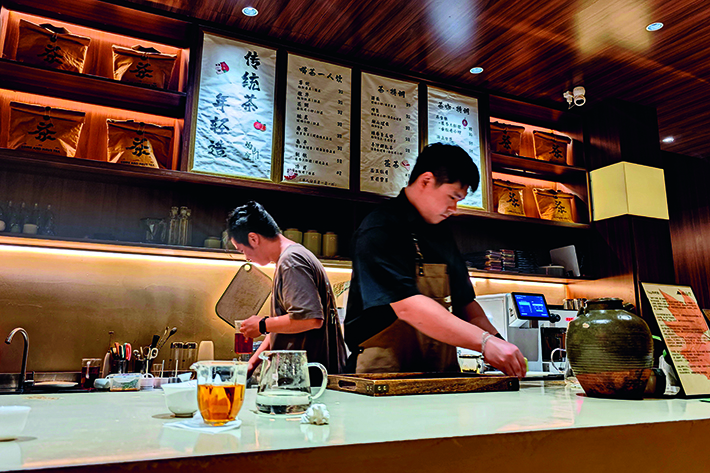
The Yushankong tea house is a popular destination for young people (YU JIE)
On the stone-paved lanes of Songyang County that date back to ancient times, morning mist lingered as a faint fragrance of tea wafted from a century-old house. Inside, Yang Junjie, a tea maker born in the 1980s, worked deftly at the stove, his hands moving swiftly over the scorching iron wok as tender green tea leaves dance between his fingers.
“More and more people enjoy the art of tea-making nowadays. They are rediscovering the value of handcrafted tea,” Yang said.
Located among the mountains in the southwestern corner of Zhejiang Province, Songyang has a long and rich history of tea cultivation and production. The county became famous for its tea as early as the Three Kingdoms period (220-280). Today, this land is home to 153,200 mu (over 10,000 hectares) of eco-friendly tea plantations. One in every three Songyang residents is involved in the tea industry, whose full industrial chain value now exceeds 13.5 billion yuan ($1.9 billion).
With the thriving tea industry creating new opportunities, a growing number of young people are returning home to start businesses. From handcrafted tea workshops to chic modern tea lounges, and from rural tea plantations to online livestream studios, this new generation of “tea makers” is infusing ancient craftsmanship with modern creativity and bringing new vitality to this age-old tradition.
Craftsmanship at the fingertips
According to Yang, as consumers increasingly seek quality and authenticity, hand-roasted tea, renowned for its flavour and cultural depth, can sell for three to five times the price of machine-processed varieties. “Last year, a customer from Shanghai drove over 600 km just to buy my tea,” he recalled. “He said machine-made tea lacks the warmth of a human touch.”
Yang’s connection with tea runs deep. Growing up beside his grandfather’s tea stove, he witnessed the craft from an early age. After leaving the army in 2009, he travelled to Hangzhou to study the techniques of Longjing tea roasting and often practiced for over 10 hours a day.
“Hand-roasted tea leaves are dense and heavy to the touch, and their aroma and taste are truly irreplaceable,” he said, cupping a handful of freshly roasted Songyang Silver Monkey tea, shimmering with silvery hairs.
Today, his Jiuchen Tea Workshop has become a well-known brand, with orders pouring in from across China. To ensure the craft lives on, Yang carefully trains apprentices, emphasising gentle and steady pressure.
In recognition of its cultural importance, Songyang has listed handcrafted tea-making as an item of intangible cultural heritage and set up a special fund to support its preservation.
Though his workshop brings in around 10,000 yuan ($1,400) in sales each month, Yang’s true goal lies elsewhere: “I just hope more people will come to appreciate the quality of Songyang’s handcrafted tea.” Inspired by his example, many young locals are now taking up this centuries-old skill.
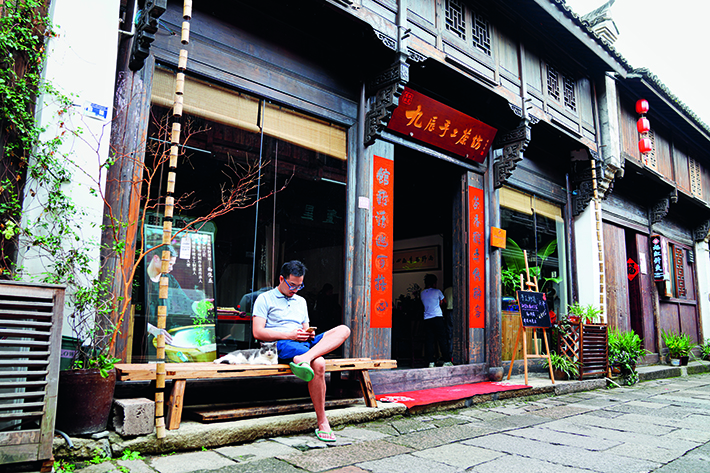
A relaxing moment at a tea house in Songyang Old Street (YU JIE)
Livestreaming tea culture
At the Southern Zhejiang Tea Market in Songyang, the largest green tea trading hub in China, the air is filled with the scent of freshly roasted leaves. Shops line the streets, farmers and traders come and go, and daily transactions reach 185 tonnes.
Sensing opportunity, locals have turned to e-commerce to expand their reach. Among the pioneers is Wang Yipeng, who returned home in 2017 after leaving a city job. At first, his parents couldn’t understand why a college graduate would come back to sell tea. But Wang had a strong instinct that Songyang’s tea industry held enormous potential.
Wang assembled a 16-member startup team and travelled across tea plantations to learn from veteran tea farmers, filming every step of the process from picking to roasting. His brand, “Tea Farmer Wang Dapeng,” has now attracted over 700,000 followers with these educational short videos across Douyin and Red Note, selling nearly 500 kg of tea daily and generating annual revenues of 30–40 million yuan ($4.2 million-$5.6 million).
Currently, Songyang hosts over 700 active e-commerce enterprises, more than half focused on the tea trade. The county has cultivated 1,650 online tea stores, and in 2024, online tea sales surpassed 5 billion yuan ($700.7 million). E-commerce has not only opened new sales channels but also created local jobs, inspiring many young people to return home and start their own ventures.
Songyang is now repositioning its tea industry with a new mindset: nationwide sourcing and selling. By establishing a complete supply system centred on Songyang Fragrant Tea and integrating six major tea categories, the county aims to become a national model for tea innovation and digital transformation.
“We’re not just selling tea,” Wang said, watching his team at work. “We’re sharing a piece of Songyang’s culture with the world.”
On this land steeped in a thousand years of tea heritage, the return of its youth has brewed not just prosperity but renewal, creativity and a vibrant new chapter in the story of Chinese tea.
| About Us | Contact Us | Advertise with Us | Subscribe |
| Copyright Beijing Review All rights reserved 京ICP备08005356号-5 京公网安备110102005860号 |


