|
||||||||||
| Home Top News Economy/Tech Culture/Sports China in Foreign Eyes Green Development Videos Intangible Cultural Heritages |
|
||||||||||
| Home Top News Economy/Tech Culture/Sports China in Foreign Eyes Green Development Videos Intangible Cultural Heritages |
| ChinAfrica |
| Artificial Intelligence, Real Emotion |
| Trainers are shaping AI to respond with empathy, gentleness and emotional understanding |
| By GE LIJUN | VOL. 18 April 2026 ·2026-04-03 |
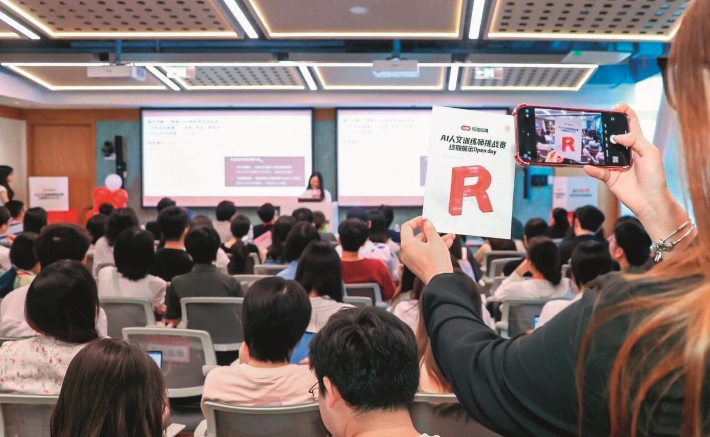
Participants attend the first AI Humanities Training Camp, jointly organised by Fudan University’s School of Philosophy and RedNote’s Humane Intelligence Lab, in September 2025 (REDNOTE)
‘AI is my best friend,” 24-year-old Yu Yang from the private training sector shared on social media. With its constant availability, efficiency and rationality, AI has become a true source of emotional support for certain users.
Young people, having grown up in the digital era and often called “AI natives,” demonstrate a high level of acceptance of AI as a companion. According to the 2025 Report on the Use of AI by Generation Z published by the Just So Soul Research Institute of the social networking app Soul, over 70 percent of young people are open to forming emotional connections with AI, and nearly 40 percent use AI daily for emotional support.
For years, users complained that AI’s responses were too mechanical and impersonal. Today, however, algorithmic advances and training shaped by the humanities are enabling AI to show empathy, gentleness and improved emotional awareness.
Humanistic AI trainers lie at the heart of this evolution. Often graduates in literature or the humanities, they enhance AI models’ relational capabilities by analysing and annotating real conversations, turning them into structured data that teaches systems to respond appropriately in various contexts.
Li Ran, a trainer at an AI company in Shanghai, explains that teams must first establish clear standards for identifying emotions, considering context and linguistic nuances. This data is then used to train models, improving their emotional intelligence.
Humanistic AI training
Companies are placing greater emphasis on this kind of training. RedNote, in early 2025, created a team for humanistic AI training, uniting humanities researchers and algorithm engineers. DeepSeek’s parent firm has also started hiring specialists to annotate text corpora to enhance the performance and quality of responses from large AI models.
Most trainers are graduates of leading universities and often have expertise in fields such as law, medicine or linguistics.
For Li Ming, a PhD student in philosophy and now a trainer at RedNote’s Humane Intelligence Lab, this work extends beyond technical improvements. “On the surface, we are training AI, but in reality, we are trying to replicate human communication mechanisms and teach it to understand the complexity of emotions,” he explained.
Although relatively rare, the development of this specialisation reflects a significant shift: AI is now intended not only to perform tasks, but also to act in a more human and responsible manner.
|
||||||||||||
| About Us | Contact Us | Advertise with Us | Subscribe |
| Copyright Beijing Review All rights reserved 京ICP备08005356号-5 京公网安备110102005860号 |


