|
||||||||||
| Home Top News Economy/Tech Culture/Sports China in Foreign Eyes Green Development Videos Intangible Cultural Heritages |
|
||||||||||
| Home Top News Economy/Tech Culture/Sports China in Foreign Eyes Green Development Videos Intangible Cultural Heritages |
| ChinAfrica |
| Of Models and Methods |
| Peking University’s ISSCAD has fostered independent development thinking across the Global South during the first decade of its operation |
| By Hu Fan | VOL. 18 June 2026 ·2026-06-01 |
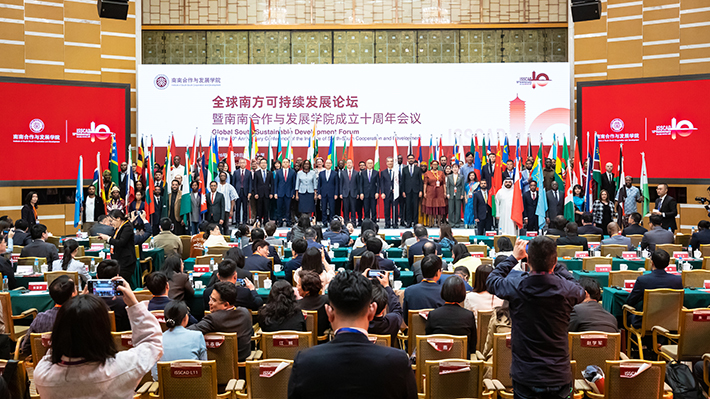
Participants at the Global South Sustainable Development Forum and the 10th Anniversary Conference of ISSCAD pose for a group photo at Peking University in Beijing on 29 April (Dong Ning)
At the Yingjie Overseas Exchange Centre of Peking University in Beijing on 29 April, 82 national flags lined the stage as the Institute of South-South Cooperation and Development (ISSCAD) marked its 10th anniversary, symbolising the institute’s connections with students from 82 countries over the past decade.
Among the alumni returning to campus for the celebration was Omani graduate Nasser Alshaqsi, who could barely conceal his excitement. One of ISSCAD’s early doctoral students, Alshaqsi now works as a learning and development manager at Alizz Islamic Bank in Oman. Reflecting on his years in Beijing, he said the most important lesson he gained was the need for countries to recognise their own development strengths and build strategies around them.
“Oman’s advantage lies in its geography,” he told ChinAfrica. “We border the United Arab Emirates, Saudi Arabia and Yemen, and face India, Pakistan and Iran across the sea. We should make full use of this location and develop into a regional hub.”
Ten years earlier, on the same date, ISSCAD was formally established at the National School of Development of Peking University, aiming to promote equitable, inclusive and sustainable growth among developing countries. Over the past decade, more than 500 degree students and over 1,100 participants in short-term programmes have studied at the institute.
Within the Qing Dynasty-style (1644-1911) courtyards of Chengze Garden on the Peking University campus, students from across the Global South gather to exchange ideas and explore pathways to development. “ISSCAD provides a diverse platform for dialogue,” Alshaqsi said. “Here we not only learn from China, but also from other developing countries.”
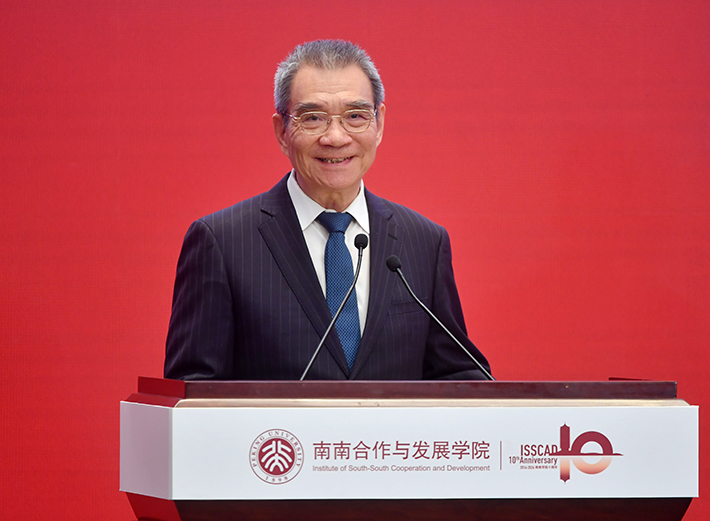
Justin Yifu Lin addresses the Global South Sustainable Development Forum and the 10th Anniversary Conference of ISSCAD at Peking University in Beijing on 29 April (Dong Ning)
A cradle of talent
The initiative to establish ISSCAD was announced by Chinese President Xi Jinping during the High-Level Roundtable on South-South Cooperation at the UN headquarters in New York in September 2015. The aim was to strengthen the sharing of development experience and enhance capacity-building cooperation among developing countries.
Since its founding, the institute has received strong support from multiple Chinese ministries. It is based at the National School of Development, which is widely recognised both as a leading academic institution and as a policy think tank. ISSCAD also draws on a broad network of faculty members and professional associates from other departments of Peking University and beyond, including senior government officials.
According to Justin Yifu Lin, honorary dean of ISSCAD, the calibre of its faculty is one of the institute’s main strengths. “Many of them were deeply involved in China’s economic reform and policy debates, while also possessing extensive international academic and professional experience,” he said. “They are committed to the cause of South-South cooperation and share China’s development story in ways that students can readily understand.”
This blend of expertise has created a dynamic interdisciplinary learning environment that encourages rigorous inquiry, open dialogue and cross-cultural exchange, while bridging theory and practice.
Field research and policy workshops form an essential part of the programme, covering areas such as education, poverty reduction, public health, urban development and foreign policy. Students are encouraged to develop conceptual tools that draw on multiple disciplines while remaining adaptable to the specific conditions of their own respective countries.
Lin believes this approach has produced tangible results. “We are pleased to see that our graduates are playing important roles after returning home, whether in shaping national policies or coordinating international cooperation,” he said. “Many have become key contributors to economic and trade cooperation with China, particularly in infrastructure and development projects.”
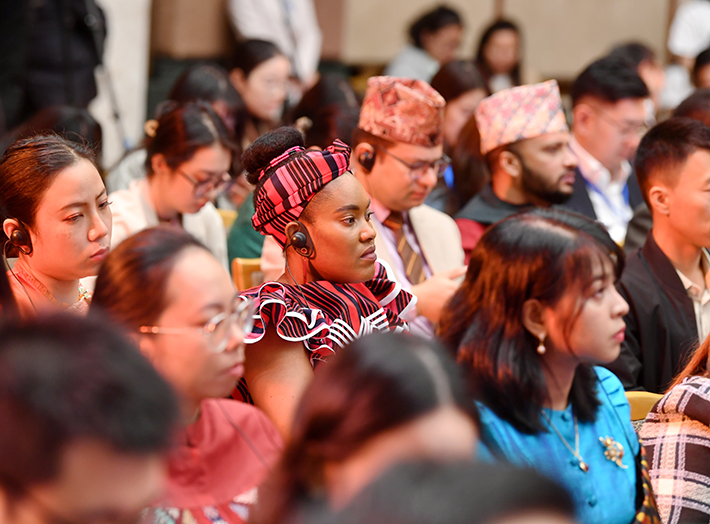
Participants attend the Global South Sustainable Development Forum and the 10th Anniversary Conference of ISSCAD at Peking University in Beijing on 29 April (Dong Ning)
A practical approach to development
Another distinctive feature of ISSCAD, according to Lin, is its effort to draw lessons from both the successes and failures of China and other developing countries, thereby broadening global development discourse beyond the long-dominant Western models.
The institute stresses that simply copying the theories and policy prescriptions of developed economies cannot guarantee success for developing countries. Instead, nations in the Global South need to explore development pathways suited to their own conditions. Lin, who has taught New Structural Economics at ISSCAD for many years, argues that developing economies should build industries based on their own factor endowments and comparative advantages.
Over the past decade, this pragmatic perspective has profoundly influenced ISSCAD’s students. Rather than relying solely on development models rooted in the historical experiences of Western countries, they are encouraged to study the economic trajectories of China and other developing economies in search of approaches better aligned with their own national realities.
Teka Entehabu, an Ethiopian doctoral student from the 2021 cohort, offered a vivid example. At ISSCAD, he did not encounter sweeping slogans about “leapfrog development” or “fundamental transformation.” Rather, what he learned was the importance of pragmatic experimentation and patient, incremental improvement.
A series of seemingly ordinary experiences left a lasting impression on Entehabu: farmers in mountainous regions trying to sell honey through livestreaming, and the gradual yet steady automation process at a BYD factory. Together, these experiences led him to realise that development is not a linear process that can be precisely calculated. Rather, it often resembles walking in the dark, requiring constant exploration, experimentation and adjustment.
Through these observations, he came to believe that sustainable economic progress cannot be achieved simply by imitating policies adopted by developed countries. Successful development, he argued, depends on a clear understanding of a country’s unique circumstances, including its institutional capacity, resource endowments and stage of development.
This perspective later shaped his work after returning to Ethiopia. When discussions emerged about cooperation with Chinese electric vehicle companies, some proposed directly introducing a complete vehicle production line. Entehabu, however, argued for starting with battery assembly instead. The technological threshold was lower, he said, allowing local workers to first become familiar with the characteristics of key components and gradually build the skills needed for future technological upgrading.
Stories like his are not uncommon among ISSCAD graduates. “Many students arrive thinking China’s development must have some secret formula,” Lin said. “But once they study here, they realise that the most important lesson is not a particular technology or policy, but the spirit of seeking truth from facts.”
Looking ahead, Lin believes the institute will continue expanding its enrolment and improving teaching quality, with the aim of building ISSCAD into an influential centre for academic innovation and talent cultivation on Global South development issues.
“Over the next decade, we hope ISSCAD will continue to support cooperation across the Global South through knowledge sharing and mutual learning from practice,” he said. “In doing so, we hope to help to turn the development aspirations of more countries into reality.”
| About Us | Contact Us | Advertise with Us | Subscribe |
| Copyright Beijing Review All rights reserved 京ICP备08005356号-5 京公网安备110102005860号 |


