| ChinAfrica |
| A Harmonious Fusion |
| When Chinese heritage meets African creativity, a traditional garment becomes a fashion phenomenon |
| By LI XIAOYU | VOL. 18 July 2026 ·2026-07-01 |
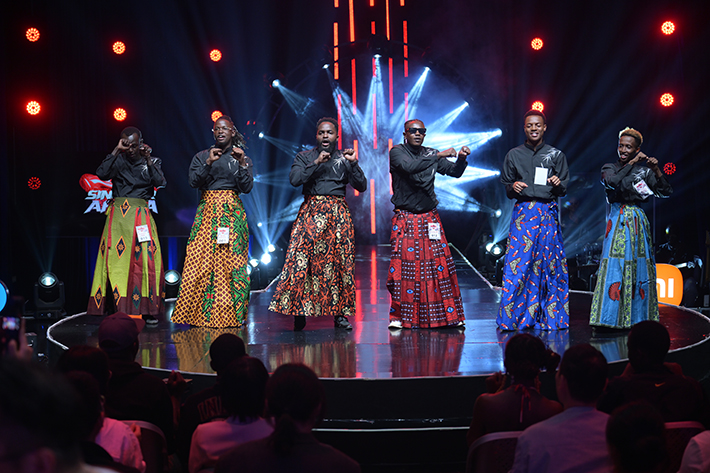
Kenyan participants wearing mamian skirts designed by Ma Xiaomei’s company in the musical reality show Sing for Africa on 29 December 2025 (XINHUA)
At a gala held in Nairobi, Kenya’s capital, during the Spring Festival celebrations in February, attention was quickly drawn to a group of Kenyan models wearing an unusual outfit: the mamian skirt, one of the most emblematic garments in the hanfu tradition. Characterised by overlapping front and back panels and elegant side pleats that create a flowing silhouette, it was paired with fabrics featuring vibrant African motifs, creating a striking visual encounter between two cultural worlds.
Long regarded as a symbol of China’s sartorial heritage, the mamian skirt is now enjoying growing success far beyond China’s borders. Across Africa, it is gradually making its mark on catwalks, at family ceremonies and even in everyday settings. For Ma Xiaomei, a Chinese entrepreneur who has lived in Africa for more than 30 years and founder of 4L International LTD and the Mara Fashion brand, this growing popularity is far more than a passing fashion trend; it demonstrates the capacity of cultures to engage in dialogue through aesthetics.
Elegance that captivates
With several decades of experience in Kenya’s textile industry, Ma has learned to identify trends that can capture the local market. It was at a Chinese cultural event in Nairobi that she recognised the potential of this traditional Chinese garment among African consumers.
“The mamian skirt enhances feminine nobility and elegance,” she explained to ChinAfrica, a view shared by Kenyan model Michelle Mutindi. Invited to wear a mamian skirt at a fashion show organised by the Chinese embassy in Kenya, she was immediately captivated. “From that day on, I fell in love with this outfit,” she confided. In her view, this particular piece allows the wearer to stand out both on the catwalk and at formal occasions.
Contrary to the sometimes-rigid image people have of traditional clothing, the garment offers several advantages, particularly appreciated in the African market. Its ample silhouette ensures great comfort, while its characteristic pleats lend it a refined air suitable for numerous occasions.
To facilitate its adoption by local audiences, Ma and her team chose to revisit certain models using African wax print fabrics. This fusion of the traditional Chinese cut and vibrant African colours has enabled Kenyan consumers to make the garment their own with natural ease.
Models and fashion professionals were among the first to adopt it, but its audience soon broadened. According to Ma, the garment now appeals to both younger generations and mature women, thanks to the balance it strikes between elegance, originality and cultural expression.
Sarah Nyawira, who runs a travel agency in Nairobi, also highlighted this versatility. She particularly appreciates the harmonious blend of Chinese and African elements and the comfort of the garment. “People always ask me where I bought it,” she said. For her, it has become the ideal outfit for important events.
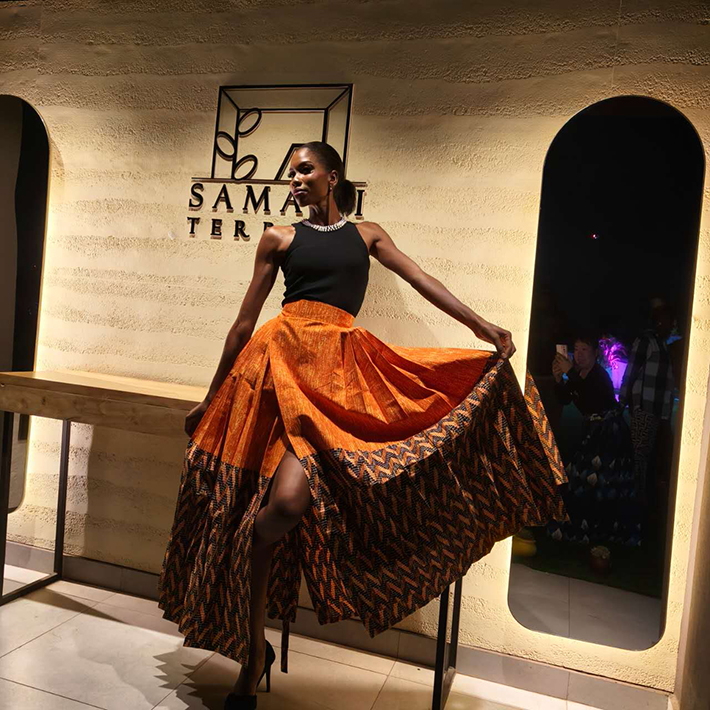
The mamian skirt is prized for the elegance and refinement it bestows upon the wearer (COURTESY)
The story behind the pleats
While the mamian skirt first attracts with its appearance, it also carries a millennia-old history. Emerging during the Song dynasty (960–1279) and popularised during the Ming (1368–1644) and Qing (1644–1911) dynasties, it ranks among the most representative forms of traditional Chinese dress.
Its name derives from the shape of its front and back panels, which recall the defensive projections found on the ramparts of ancient Chinese cities. Its distinctive structure, composed of side pleats and flat panels, combines functionality and aesthetics. Originally, this design facilitated horse riding while preserving the garment’s elegance.
Over the centuries, the mamian skirt became a symbol of Chinese aesthetics, founded on balance, harmony and refinement. Even today, it embodies a living link between heritage and modernity. Its recent resurgence in popularity in China testifies to a growing interest among younger generations in their cultural heritage.
Mindful of this historical dimension, Ma ensures that every piece sold in Africa is accompanied by a presentation explaining the origin and cultural significance of this traditional garment. “Customers are not merely discovering a garment; they are also discovering a part of China’s history,” she emphasised.
This approach helps to transform a simple fashion product into a genuine vehicle for cultural dialogue. Through a skirt, an entire narrative about Chinese civilisation travels to the African continent.
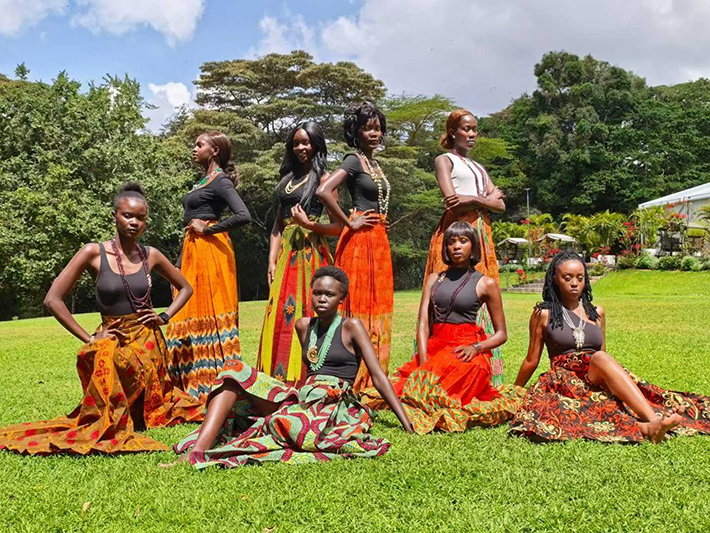
Presentation of various mamian skirt designs created by Ma Xiaomei’s company in Nairobi, Kenya, on 25 May 2025 (COURTESY)
Fashion as a bridge
The success of the mamian skirt in Africa cannot be explained by its aesthetic qualities alone. It also reflects a deeper evolution in China-Africa exchanges, where culture now occupies an ever-greater place alongside commerce and infrastructure.
For Ma, the key lies in creating an authentic encounter between the two cultures. It is in this spirit that she chose to develop the Mara Fashion brand in Kenya. The name Mara, borrowed from the Maasai language, evokes the vast plains of the Masai Mara, one of Kenya’s most emblematic natural sites, while serving as a familiar reference for local consumers.
This localisation strategy is supported by ongoing efforts to integrate African elements into creations inspired by hanfu. Fabrics, colours and certain motifs draw on the continent’s aesthetic imagination while preserving the essence of the traditional Chinese cut.
The fashion shows held in Nairobi perfectly illustrate this approach. Watching Kenyan models walk in mamian skirts made from African fabrics, the audience discovers a hybrid creation that is neither imitation nor assimilation, but a genuine artistic dialogue.
For model Nyakuar John, the experience goes far beyond fashion. “This outfit brings together two cultures; it looks African while remaining profoundly Chinese,” she said, recalling having to learn a new way of tying a skirt, a discovery she described as both enriching and amusing. The photographs she posted on social media received numerous positive reactions.
“Fashion knows no borders,” Ma added. In her eyes, the rise of the mamian skirt in Africa represents a unique opportunity to introduce China’s 5,000-year history to a wider audience while enabling Chinese people to better understand African cultures. By combining cultural heritage, creative innovation and economic cooperation, this traditional garment thus opens new perspectives for people-to-people exchanges between China and Africa.
| About Us | Contact Us | Advertise with Us | Subscribe |
| Copyright Beijing Review All rights reserved 京ICP备08005356号-5 京公网安备110102005860号 |


