| ChinAfrica |
| 105 Years of Exemplary Leadership |
| The CPC's governance practices offer experiences of considerable interest not only to China, but also to the wider world |
| By Charles Onunaiju | Web Exclusive ·2026-07-04 |
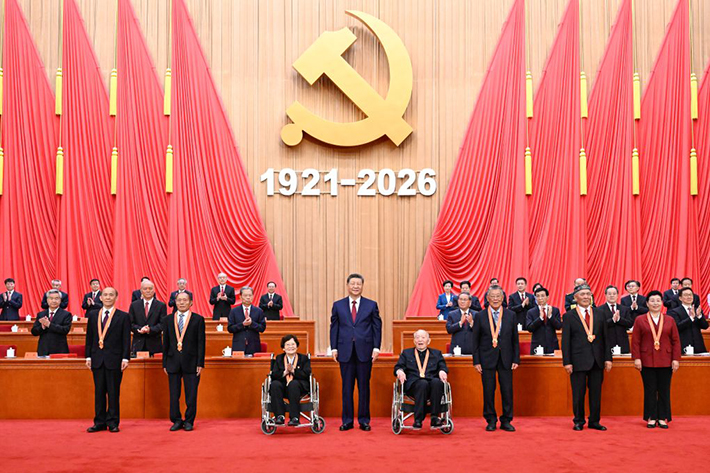
Chinese President Xi Jinping, also general secretary of the CPC Central Committee, confers the July 1 Medal, the Party's highest honour, on model CPC members in Beijing on 1 July (Xinhua)
Imagine a 105-year-old political party that remains progressive and vigorous, leading a country of 1.4 billion people towards common prosperity. This is the Communist Party of China (CPC). On 1 July, the Party celebrated its 105th anniversary in Beijing.
At the gathering, President Xi Jinping, who is also general secretary of the CPC Central Committee, noted that the Party's endeavours over the past 105 years have fundamentally transformed the future of the Chinese people, blazed the right path towards the great rejuvenation of the Chinese nation, demonstrated the enduring vitality of Marxism, profoundly influenced the course of world history, and built the CPC into a powerful Communist Party.
Under the CPC's leadership, China has become the world's second-largest economy, emerged as one of the world's leading innovators, raised the average life expectancy of its people to more than 79 years, and established the world's largest education, social security, and health care systems.
"It is imperative that all of us in the Party never forget our original aspiration and founding mission, that we always stay modest, prudent and hard-working, and that we have the courage and ability to carry on our fight," he added.
A strong political force
The most potent political force in any society for articulating a vision, promoting change, consolidating stability and advancing progress is the political party. How it is organised, nurtured and governed determines, to a large extent, how efficiently and competently the broader affairs of society are managed.
A political party is not an automated machine whose structure is fixed for every stage of its existence. Rather, it is a living organism that evolves from its historical point of departure, adapting to changing times and circumstances without losing sight of its original purpose and ultimate goal of improving the lives of the people it was founded to serve.
The life of a political party is often tempestuous and arduous. Therefore, the structures that enable it to achieve its goals, and the philosophy that guides its trajectory, must be rigorously governed, continuously renewed and carefully nurtured. Otherwise, it will relapse into complacency and eventually atrophy. A political party is not a mere formality. It is a living institution and a repository of historical memory that serves the broader purpose of social renewal. This is most clearly reflected in its governance capacity, which must continually adapt to deliver meaningful improvements in people's living standards.
In his more than 500-page book From Rebel to Ruler: One Hundred Years of the Chinese Communist Party, Professor Anthony Saich of the Ash Centre for Democratic Governance and Innovation at the Harvard Kennedy School writes: "There is no other political party quite like the CPC. The Party's longevity, size, endurance and ability to overcome seemingly impossible odds make it a very distinct political organisation."
However, distinct as the CPC may be, its experience in overseeing and producing some of the most remarkable achievements of the past century - including the eradication of extreme poverty, unparallelled production capacity, sustained economic growth, and the provision of the world's largest public goods - offers lessons of considerable interest not only to China, but also to the wider world. The CPC is a party shaped by an extraordinary historical context, yet it does not treat history merely as a record of the past. Rather, it views history as a force that helps to shape social change, identify opportunities, minimise risks, overcome challenges and advance progress measured by tangible improvements in people's quality of life.
In its 105-year history, what has enabled the CPC to remain so vigorous and forward-looking while also serving as a repository of historical memory? Since the 18th CPC National Congress in 2012, it has dedicated itself to rigorous and strict internal governance, while advancing efforts to improve Party conduct and build a clean government.
According to the resolution adopted at the 18th CPC National Congress, some malfeasances that had not been checked for many years have been curbed; intractable problems of long standing have been resolved; while serious hidden dangers within the Party, the state, and the armed forces have been removed. Lax and weak governance in the Party has been fundamentally reversed. The CPC's outlook and governance capacity have improved significantly, and the essential key to maintaining its vitality has been self-reform and strict self-governance. According to President Xi, self-reform is like the Party giving itself supplements to strengthen its bones. It is like performing painful surgery to remove a maimed limb, or eliminating viruses and bacteria that erode your immunity. The aim is to boost the Party's health, achieve self-renewal and prevent its collapse.
The establishment of Xi Jinping Thought on Socialism with Chinese Characteristics for a New Era, a theoretical framework that rejuvenated the Party and clarified its vision for the new era, further reinforced its commitment to strict self-governance and provided a firmer foundation for governance. By reforming itself and, in keeping with its tradition, establishing a theoretical guide to maintain its vitality and resourcefulness, the Party has not only delivered stable, steady and inclusive growth for the Chinese people, but has also assumed greater international responsibility by providing public goods with global significance.
As a party with an internationalist outlook, the CPC has put forward important initiatives to address critical gaps in international governance, development and security. It has proposed pathways towards building a community with a shared future for mankind and made significant practical contributions through the Belt and Road Initiative (BRI), launched in 2013 and described as the "project of the century."
Useful lessons
The uniqueness of the CPC does not preclude the important and consequential lessons its experience offers. In recent years, one of Africa's oldest political parties, South Africa's African National Congress (ANC), has faced numerous challenges in both its internal governance and state governance. These have led to breakaway factions establishing their own political parties and have coincided with a growing incidence of xenophobic violence. The CPC has demonstrated that a party with a long history of liberation and revolutionary struggle cannot rely solely on such credentials, however significant they may be. It must continually strengthen its competence and effectiveness through internal renewal and strict self-governance.
Nigeria, which has been struggling to establish a viable party system since its return to civilian rule in 1999, can do much more to build coherent party structures through organisational discipline, an attribute exemplified by the CPC more than any other political party in the world. Despite having more than 100 million members, the CPC remains highly disciplined and organisationally effective, and this accounts in large part for its vitality despite its 105-year history.
Therefore, whether within a competitive multiparty political system such as those in Nigeria and some other African countries, or within China's CPC-led multiparty cooperative and political consultative system, discipline and strong party organisation, combined with a considerable degree of internal democracy, are essential to building a viable party system. The important lesson from the CPC is that a political party must neither seek privilege and entitlement for itself nor allow special interests to develop within its ranks. These are clear recipes for internal weakness and decline.
A political consultative framework is not antithetical to competitive multiparty politics; rather, it reinforces the broader social purpose of political competition by strengthening and consolidating consensus. Nigeria, and Africa more broadly, are at an inflection point, with strategic advantages and opportunities similar to those China faced in the late 1970s and 1980s. The CPC reinvented and adapted itself to seize those opportunities, laying the foundation for China's remarkable rise.
The question that many political parties in Nigeria and the rest of Africa must answer is how prepared they are to seize the opportunities of the new era. The CPC's experience provides useful lessons, but the strategies and solutions must be uniquely Nigerian and African, reflecting the specific characteristics of each country.
Editor’s Note: Onunaiju is Director of the Centre for China Studies in Abuja, Nigeria, and the author of A Century of the Communist Party of China: Why Africa Should Engage Its Experience.
| About Us | Contact Us | Advertise with Us | Subscribe |
| Copyright Beijing Review All rights reserved 京ICP备08005356号-5 京公网安备110102005860号 |


