| ChinAfrica |
| From Small Commodities to Global Reach |
| Over two decades, Yiwu has evolved into a global trading centre, offering new perspectives on Chinese modernisation and international commerce |
| Wang Wen, Liu Ying | Web Exclusive ·2026-07-07 |
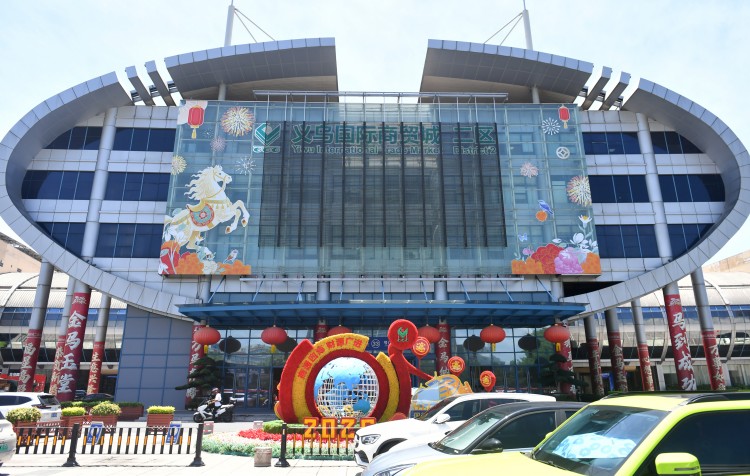
The building of Yiwu International Trade Market shot on 6 July (Dong Ning)
Twenty years ago, Xi Jinping, then secretary of the CPC Zhejiang Provincial Committee, famously described Yiwu's development miracle as turning the impossible into the possible, creating something out of nothing and making gold from stone. From an obscure county town at the start of China's reform and opening up in late 1970s, Yiwu in east China’s Zhejiang Province has grown into the world's leading hub for small commodities. Its story has long transcended a simple narrative of market success. Today, Yiwu offers an important window into Chinese modernisation, providing insight into China's development model and a glimpse of the future of globalisation.
Over the past two decades, Yiwu has demonstrated a distinctive development path: remaining committed to market-oriented reform while fostering an active, service-oriented government; embracing global trade while maintaining strong local manufacturing; and encouraging individual entrepreneurship while advancing shared prosperity. This combination of an effective market and a proactive government is a defining feature of Chinese modernisation.
The secret to success
Yiwu's rise can be traced to its long tradition of "trading chicken feathers for sugar." With limited land and scarce natural resources, local people transformed a grassroots trading culture into a thriving modern marketplace during the reform and opening up period, turning a modest open-air market into the world's largest wholesale centre for small commodities.
Today, Yiwu offers more than 2.1 million types of products through trade networks that span over 230 countries and regions. Yet, more significant than its scale is the development model that underpins its success.
On the one hand, the government has acted as a facilitator by investing in infrastructure, improving logistics networks, optimising the business environment and reforming regulatory systems to remove barriers and create favourable conditions for market growth. On the other hand, it has protected the vitality of the private sector, enabling millions of small business owners to establish enterprises with low barriers to entry, operate at low cost and trade efficiently.
This model, in which ordinary people create markets, government supports markets and markets connect with the world, differs from both state-dominated economic systems and capital-driven monopolistic markets. Its dynamism stems from millions of individual entrepreneurs who can enter the market with minimal barriers, complete transactions efficiently and earn tangible returns. Through institutional innovation, the government has created opportunities for ordinary people while preventing unchecked capital expansion and market monopolies, ensuring that the benefits of development are shared widely across society. That, ultimately, is the enduring strength of the Yiwu model.
Global lessons
For many years, some Western narratives have attributed China's development miracle primarily to cheap labour or state subsidies. Yiwu's rise, however, tells a different story. China's competitive strength lies in its exceptional ability to organise markets, coordinate industrial ecosystems and build highly efficient supply chains.
For many people across Europe and Africa, Yiwu is already a familiar name. From neighbourhood shops in Africa and wholesale markets in south France to port warehouses in North Africa and cross-border trade hubs in Central and Eastern Europe, Yiwu-made products have become part of everyday commerce. What Yiwu connects is not only the movement of goods, but also the livelihoods and aspirations of developing countries, millions of small businesses and countless ordinary families around the world.
For Africa, Yiwu offers an inclusive development model worthy of close attention. The continent has the world's youngest population and enormous consumer potential, yet many countries continue to face challenges such as limited industrial capacity and underdeveloped supply chains. Yiwu demonstrates that even without abundant natural resources, a region can build global competitiveness by fostering an open and efficient market ecosystem, reducing transaction costs and unlocking grassroots entrepreneurship. In Yiwu, countless family workshops and small businesses have gained access to international markets through marketplace platforms. This small and medium-sized enterprise-led development model has particular relevance for many African economies.
For Europe, Yiwu provides a window into economic resilience. Despite growing rhetoric in recent years around "de-risking" and economic decoupling, the city's trade has remained vibrant. The reason is straightforward: Yiwu is connected to the broadest and most enduring sources of global demand. It represents a form of people-centred globalisation that serves ordinary households, small businesses and entrepreneurs. Whatever shifts may occur in international politics, a globalisation rooted in the everyday needs of billions of people retains enduring vitality.
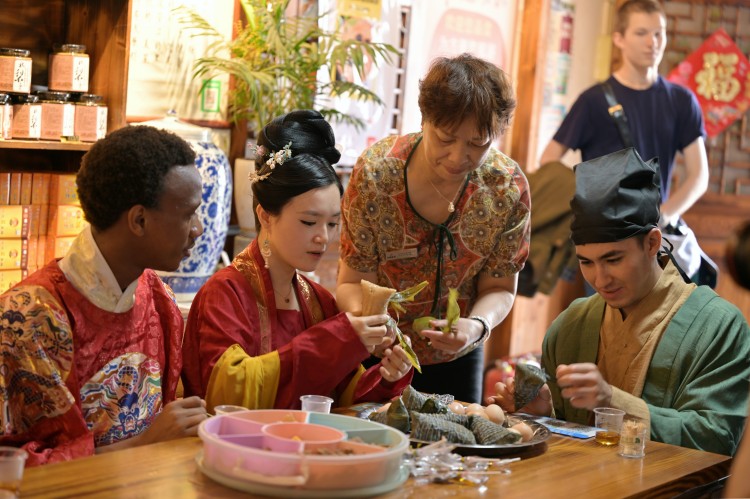
International students from Yiwu Industrial and Commercial College experience traditional Chinese Dragon Boat Festival culture in hanfu clothes on 18 June (COURTESY)
An evolving model
As globalisation undergoes profound restructuring, Yiwu is rapidly expanding beyond traditional commodity trade into new forms of commerce, including digital trade, cross-border e-commerce and overseas warehousing. It is evolving from a city that buys and sells globally into one that connects markets and serves the world. As the Yiwu model continues to evolve, it is bringing renewed certainty to an increasingly uncertain global economy.
One of Yiwu's defining characteristics is its openness and inclusiveness. Today, more than 15,000 foreign merchants live and work in the city, with people from over 100 countries and regions living side by side and building businesses together. Yiwu is not only a global trade hub, but also a centre for cultural exchange, offering a vivid example of an interconnected and diverse world. At a time when protectionism is gaining ground, the principle that Yiwu embodies openness, cooperation and mutual benefit represents a meaningful contribution to the future of globalisation.
As an important hub for South-South cooperation, Yiwu not only supplies affordable, high-quality goods to developing countries, but also provides an important window through which they can observe China's experience of marketisation and industrialisation. From the humble tradition of "trading chicken feathers for sugar" to becoming the "world's supermarket" and now a global commercial hub, Yiwu's story demonstrates that there is no single path to modernisation. Every country can chart its own course based on its national conditions and pursue prosperity through openness and cooperation.
At the 2026 Summer Davos forum held in Dalian, China in June, Chinese Premier Li Qiang observed that the world's perception of China is shifting from "China shock" to "China opportunity". Yiwu's development over the past two decades offers a compelling grassroots illustration of this transformation. When Yiwu merchants use AI-powered multilingual customer service to serve buyers around the world, when young Africans study in Yiwu and return home to establish businesses and when the China-Europe "Yiwu-Xinjiang-Europe" freight trains serve as reliable arteries of Eurasian supply chains, Yiwu gives tangible expression to the idea of "China opportunity."
After two decades of development, Yiwu demonstrates how Chinese modernisation can generate new opportunities for global growth.
Wang Wen, Dean, Chongyang Institute for Financial Studies, School of Global Leadership, Renmin University of China
Liu Ying, Research Fellow, Chongyang Institute for Financial Studies, Renmin University of China
| About Us | Contact Us | Advertise with Us | Subscribe |
| Copyright Beijing Review All rights reserved 京ICP备08005356号-5 京公网安备110102005860号 |


