| ChinAfrica |
| Smart Weaving |
| An AI-powered blanket factory in Yiwu shows how China’s traditional manufacturing base is being rewoven for the digital age |
| By Cui Xiaoqin | VOL. 18 August 2026 ·2026-07-23 |
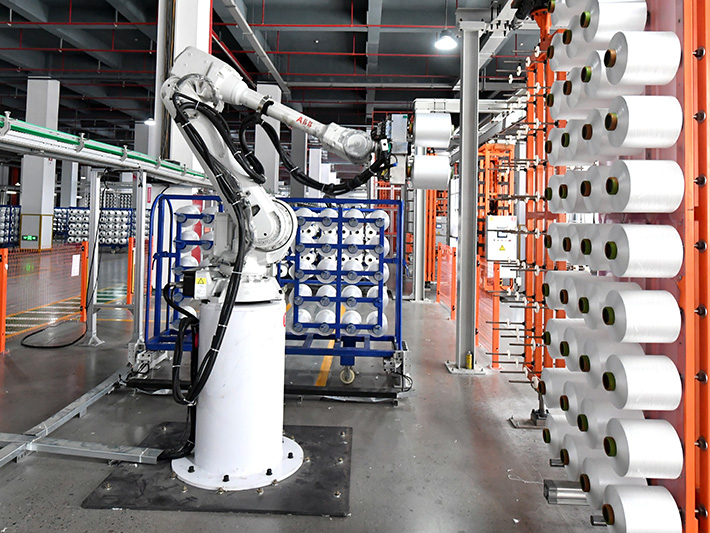
An intelligent robotic yarn-loading system operates in Truelove’s production workshop in Yiwu, Zhejiang Province, on 7 July (DONG NING)
In a busy knitting workshop in Yiwu, Zhejiang Province, nearly 100 warp knitting machines hum in unison. Suddenly, one of them stops. The reason is almost imperceptible: a single polyester thread has snapped.
Within moments, a worker reconnects the thread, presses a button, and the machine resumes production. Although the interruption lasts no more than two minutes, it illustrates a profound shift taking place in one of China’s most traditional manufacturing sectors.
The machine does not stop because a worker spots the problem. It stops because an AI-powered machine vision system does.
“Electronic eyes monitor every yarn around the clock,” explained Pan Hao, chief engineer of intelligent manufacturing at Truelove Blanket Technology. “The moment an abnormality is detected, the machine automatically stops and sends an alert.”
The seemingly ordinary incident reflects something far larger than quality control. It represents Yiwu’s broader journey from labour-intensive manufacturing to intelligent production, one that is redefining what “made in Yiwu” means.
Retooling the factory floor
Founded in the early 1980s, Truelove traces its roots to a modest stall in Yiwu’s famous small commodities market. Over four decades, it has grown into one of China’s leading blanket manufacturers, with an annual production capacity approaching 60,000 tonnes. Today nearly 88 percent of its revenue comes from overseas markets, with products exported to the Middle East and across Africa.
Behind this success, however, lay a stubborn problem.
Blanket manufacturing remains a highly labour-intensive industry, and broken yarn has long been one of its greatest production headaches. Under conventional methods, a snapped thread could go unnoticed for several minutes or longer while the knitting machine kept running. By the time workers discovered the fault, metres of defective fabric might already have been produced.
“In the past, factories constantly struggled with labour shortages, rising costs and relatively low efficiency,” Pan said. “These challenges limited production capacity, product quality and overall competitiveness. We realised the traditional production model had reached its limits.”
Truelove’s challenge was hardly unique. Yiwu has long been known as the world’s largest wholesale market for small commodities, home to more than 80,000 market booths and around 2.1 million different products traded with buyers from over 230 countries and regions. For decades, its manufacturing success rested largely on abundant labour and economies of scale.
As labour costs rose and global competition intensified, however, Yiwu faced a new question: how could it move from an economy powered by hard work to one driven by intelligence and innovation?
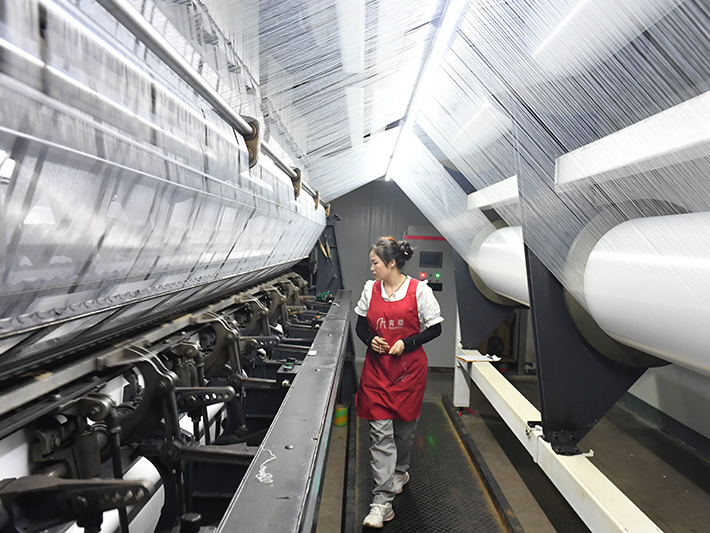
A worker inspects yarn in Truelove’s warp knitting workshop in Yiwu, Zhejiang Province, on 7 July (DONG NING)
Rebuilding production from the ground up
The answer for Truelove was not simply to install new machines. It was to redesign the entire production system.
In 2022, in partnership with companies including China Telecom and China Mobile, Truelove launched its 5G Future Factory project. After nearly three years of construction, eight advanced production lines were fully operational.
Inside the knitting workshop, every machine is now equipped with 24 industrial cameras. Using 5G connectivity, AI inspection models are transmitted directly to the cameras, allowing defects to be identified in real time as the fabric is knitted.
The results have been dramatic. Undetected defects have fallen by 90 percent. Detection accuracy has reached 99 percent. Annual labour costs have been reduced by nearly 3 million yuan (about $440,000), while raw material losses have fallen to roughly a third of previous levels.
Inspection efficiency has also improved sharply. Earlier, each textile worker could supervise only two or three knitting machines. Today workers routinely oversee more than a dozen at once.
“The overall workload hasn’t necessarily become lighter, because the factory has expanded several times over,” said Deng Rong, a workshop supervisor who has worked for the company for many years. “But our productivity has increased enormously, and our salaries have improved as well.”
The impact extends beyond inspection. More than 1,400 units of equipment across the factory are now connected through an integrated digital network that collects over 500,000 data points every second. Production plans can be distributed instantly to manufacturing terminals. Equipment automatically requests materials, reports completed tasks and synchronises information across the factory.
Even warehousing has become largely autonomous. A 38-metre-high automated storage facility manages both incoming raw materials and finished products with minimal human intervention, letting materials flow efficiently between production stages.
The factory’s digital twin adds another layer of intelligence. Large electronic displays in the control centre and on the production floor show real-time visualisations of factory operations. By simulating the entire manufacturing process, managers can optimise production schedules, predict delivery cycles and identify potential bottlenecks.
The combination of physical production and digital simulation earned Truelove recognition as a Zhejiang Provincial Future Factory in 2025.
Innovation has extended into sustainability too. Solar panels installed across factory rooftops have generated millions of kilowatt-hours of electricity. Waterless printing and dyeing technologies have cut water consumption by more than 70 percent.
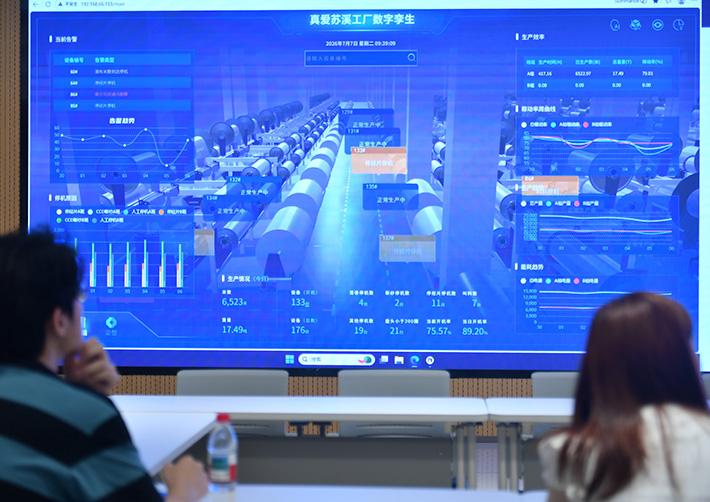
The digital twin platform at Truelove’s factory in Yiwu, Zhejiang Province, on 7 July (DONG NING)
A wider transformation in Yiwu
Truelove’s story reflects a much broader industrial transition taking place across Yiwu.
In Dachen Town, often called China’s town of shirts, another traditional industry is undergoing its own digital revolution. The town produces around 130 million shirts annually, making it one of the country’s largest specialised shirt manufacturing centres.
At garment company Tianchi, which has more than three decades of history, digital production systems have dramatically shortened customised manufacturing. From body measurement to finished garment, a tailor-made shirt can now be completed in only 40 minutes.
“Our priority is using digital and intelligent technologies to turn designs into products much faster,” said company executive Jin Mingkang.
In December 2025, the Yiwu Digital and Intelligent Industry Community officially opened in Dachen, a project with total investment of approximately 2 billion yuan ($295 million). Thirty-eight companies became its first tenants, forming a new cluster designed to accelerate intelligent manufacturing across multiple industries.
From blankets to shirts, traditional manufacturers across the city are increasingly embracing digital and smart technologies, and behind the shift lies a coordinated strategy.
Yiwu has established a structured pathway for industrial digitalisation, guiding companies from lightweight digital improvements to digital workshops, intelligent factories and ultimately future factories. Dedicated government funding supports enterprises investing in technological upgrades, reducing the financial risk of large-scale modernisation.
From a small stall in Yiwu’s bustling marketplace to a future factory powered by data and AI, Truelove’s journey mirrors the transformation of the city itself. The story of a single broken thread has become a symbol of a much larger shift: traditional industries are not being replaced by technology, but reshaped by it. As Yiwu’s manufacturers continue to embrace digitalisation, automation and innovation, the city is weaving a new chapter for “made in China” in the digital age.
| About Us | Contact Us | Advertise with Us | Subscribe |
| Copyright Beijing Review All rights reserved 京ICP备08005356号-5 京公网安备110102005860号 |


