| ChinAfrica |
| Cultivating Opportunity in the Desert |
| China is combining ecological restoration, scientific innovation and local industry to transform deserts into engines of sustainable development |
| By Ge Lijun | VOL. 18 September 2026 ·2026-09-02 |
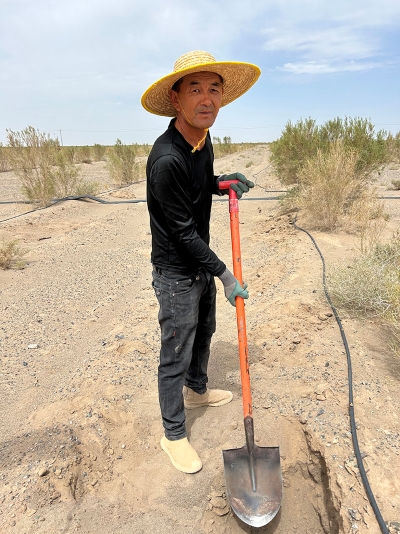
Zhang Zhanxue, an employee of Damo Nonglin, inspects the irrigation network for saxaul trees in Jinta County, Jiuquan, Gansu Province, on 5 June (GE LIJUN)
In early summer, Jinta County in northwest China’s Gansu Province offers an unexpected sight. Where there was once a vast expanse of gravel and sand, a green belt stretching more than 50 km now borders the western edge of the Badain Jaran Desert. Saxaul plantations covering nearly 516,000 mu (34,400 hectares) have transformed the landscape.
Standing beside a saxaul shrub, Zhang Zhanxue, an employee of Damo Nonglin, points to cistanche, a medicinal plant that grows naturally on the roots of saxaul trees. Nearby, a network of drip irrigation pipes underscores the preciousness of water in this arid landscape.
Situated between the Badain Jaran and Kumtag deserts, nearly two-thirds of Jinta’s territory is affected by desertification. For several decades, the local authorities have implemented an ecological restoration policy centred on the large-scale planting of saxaul trees. This strategy is complemented by the cultivation of crops suited to desert conditions, such as cistanche and cynomorium, two plants used in both traditional medicine and food. The aim is clear: to make the fight against desertification a driver of sustainable development by balancing ecological, economic and social benefits.
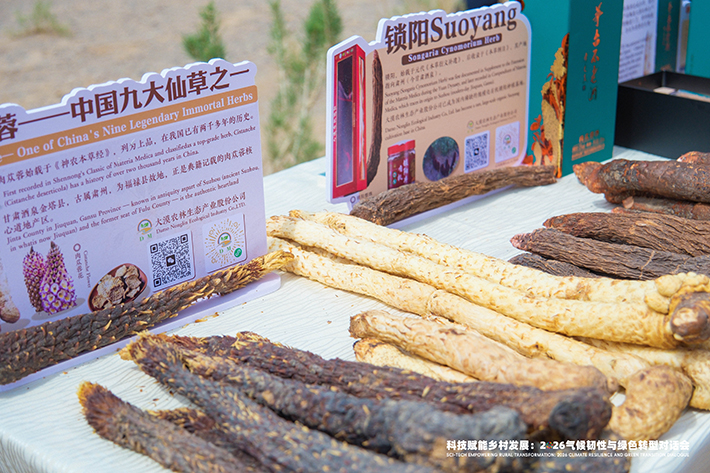
A display of cistanche and cynomorium, cultivated in Jinta County, Jiuquan, Gansu Province, on 5 June (CICG)
From restoration to prosperity
“Sandstorms used to be much more frequent. Today, vegetation has greatly reduced their impact,” said Zhang, who is in his fifties. The change is tangible. It is now much rarer for wind-blown sand to sting people’s faces.
A former employee in the oil sector, he joined Damo Nonglin in March, where he helps to maintain the saxaul plantations. His job involves carrying out daily inspections of a plot measuring 200 metres wide by 1 km long, checking irrigation pipes, unblocking water outlets and replacing damaged parts.
“After the irrigation season, we work on trimming plants and preparing cistanche. We earn more than 5,000 yuan ($737) a month,” he told ChinAfrica.
Like Zhang, many local residents have found stable employment through the growing desert economy. Their jobs are the product of decades of sustained efforts to reclaim degraded land. Since the 1950s, the local government has pursued an ambitious programme to combat desertification. According to Huang Xiaochun, head of Jinta County, 850,000 mu (56,667 hectares) of desert have been reforested and 539,000 mu (35,933 hectares) of sandy land placed under protection. As a result, the area affected by desertification and sand encroachment has steadily shrunk for more than two decades.
These results are largely due to scientific and technological advances. Jinta has a long-standing partnership with Lanzhou University and the Gansu Desert Control Research Institute to develop new techniques for stabilising dunes, improve methods for planting saxaul trees and refine cistanche cultivation.
At the same time, the local authorities have stepped up financial support to encourage local businesses to get involved. Damo Nonglin, which specialises in afforestation and processing, is one of these businesses. Its chairman Hu Bing, a native of Jinta, grew up in an environment plagued by sandstorms and has long dreamed of helping to restore his region. His company has developed a model that combines ecological restoration with agricultural production, helping to ensure the long-term financial sustainability of efforts to combat desertification.
Cistanche is now an important economic resource. Its seeds are sown near saxaul trees in their third year of growth, and the plant is harvested two to three years later. The company cultivates around 160,000 mu (10,667 hectares) of cistanche and 30,000 mu (2,000 hectares) of cynomorium, a parasite of Nitraria tangutorum. It has developed more than 20 derivative products.
The annual harvest of medicinal plants amounts to around 3,000 tonnes, generating more than 100 million yuan ($14.75 million) in annual revenue. This model creates a virtuous circle, with revenue from medicinal plants funding further planting and ecological restoration.
Public initiatives are also contributing to this effort. In 2019, the Ant Forest programme run by Alipay, the mobile app of Internet company Ant Financial, began funding the planting of saxaul trees in Jinta. According to Wang Xiaoying, secretary general of the Ant Forest Foundation, nearly 120 million yuan ($17.7 million) has already been raised, enabling the planting of more than 23 million trees across more than 230,000 mu (15,333 hectares) in Jinta.
“Our experience shows that the fight against desertification must go hand in hand with improving people’s living conditions,” Lei Jiaqiang, a researcher at the Xinjiang Institute of Ecology and Geography of the Chinese Academy of Sciences, told ChinAfrica. According to him, similar models are currently being developed in Xinjiang, Hexi Corridor in Gansu and Alxa League in Inner Mongolia.
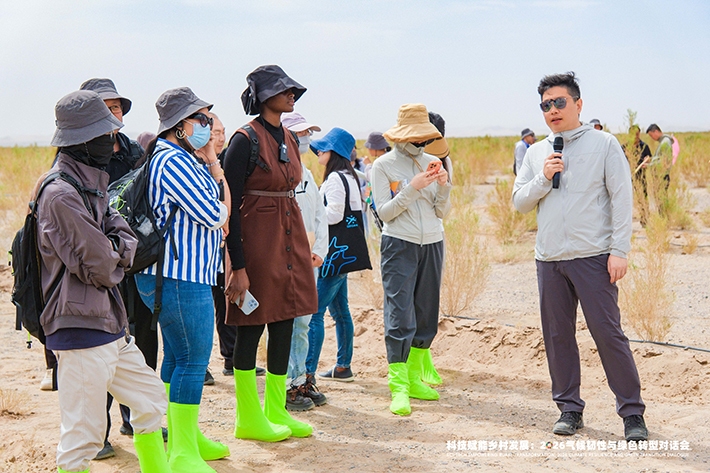
Chinese and foreign visitors tour one of the desertification control areas in Jinta County, Jiuquan, Gansu Province, on 5 June (CICG)
Sharing green solutions
The Chinese experience now extends beyond national borders. It is being applied in other regions affected by desertification, notably Mauritania.
An hour and a half’s drive from Nouakchott, near the village of Bir El Barka in the Trarza region, an oasis has sprung up amid the dunes. The China-Africa Green Technology Park is a demonstration project jointly developed by China and Mauritania, with technical support from the Xinjiang Institute of Ecology and Geography of the Chinese Academy of Sciences.
Chinese experts have adapted their methods to local conditions. In an interview with People’s Daily, Pang Guocong, Sinoway Forest Technology’s representative in Mauritania, said training programmes had equipped local technicians with skills in planting, nursery management and irrigation system maintenance. Mauritanian teams now independently manage the site’s day-to-day operations.
The project also combines solar power, smart soil moisture monitoring and automated irrigation to make more efficient use of scarce water resources. According to Lei, these innovations have already enabled fruit and vegetables to be grown in the Mauritanian desert.
This cooperation forms part of a broader international strategy. China has established the China-Africa Environmental Cooperation Centre and participates in several platforms dedicated to combating desertification in Mongolia, the Arab world and Central Asia. These initiatives promote joint research, technology transfer and the sharing of experience. “These demonstration platforms play an irreplaceable role in disseminating Chinese technologies and methods,” Lei said.
Looking ahead, China plans to deepen this cooperation, particularly in the ecological restoration of the Aral Sea, the construction of Africa’s Great Green Wall and scientific cooperation under the Belt and Road Initiative. The goal is to make a greater contribution to the global fight against desertification, Lei said.
| About Us | Contact Us | Advertise with Us | Subscribe |
| Copyright Beijing Review All rights reserved 京ICP备08005356号-5 京公网安备110102005860号 |


