| ChinAfrica |
| Turning the Tide |
| China shares its experience to help African countries combat desertification |
| By Li Xiaoyu | VOL. 18 September 2026 ·2026-09-02 |
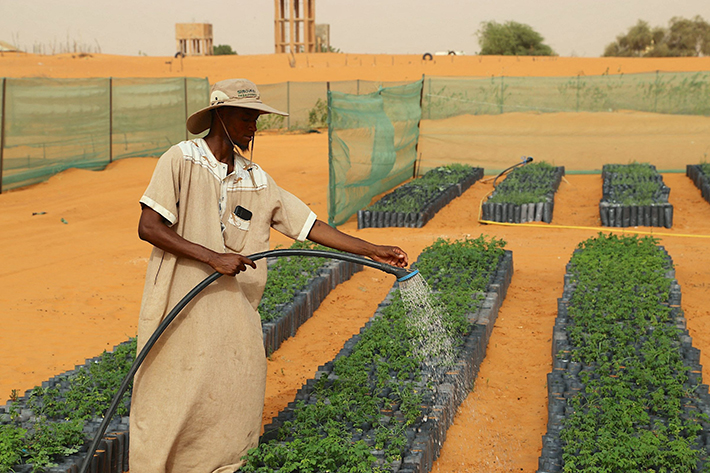
A worker manually waters plants at the China-Africa Green Technology Park in Bir El Barka, Trarza region, Mauritania, on 22 May 2025 (XINHUA)
In Bir El Barka, a village in Mauritania’s Trarza region, about 70 km east of the capital Nouakchott, a quiet but profound transformation is taking place. Where barren desert once stretched across the landscape, rows of vegetables now grow in sandy soil. Drip irrigation pipes run between the plots, while solar-powered pumps draw underground water to nourish the crops.
The change is the result of the China-Africa Green Technology Park, a pilot project jointly developed by China and Mauritania. Supported by the Xinjiang Institute of Ecology and Geography (XIEG) under the Chinese Academy of Sciences, the project explores a sustainable development model suited to Africa’s arid regions. Completed in July 2024, the four-hectare park includes areas for sand fixation, orchards, vegetable cultivation, forage plants and poultry farming.
The site faced chronic drought, extreme heat, frequent sandstorms and highly saline soils. Agricultural infrastructure was limited, and local residents had long relied mainly on traditional livestock farming, with few stable sources of income. For the Chinese researchers involved, ecological challenges and development needs were closely intertwined.
To address these challenges, the team introduced and adapted technologies developed in China’s Xinjiang Uygur Autonomous Region, including smart irrigation systems, nylon sand-control grids, photovoltaic-powered water pumps, sandy-land cultivation techniques and soil improvement methods.
Within its first year, the park produced about 900 kg of fruits and vegetables, including carrots, beets, mung beans and watermelons. The first harvest was distributed free of charge to residents of surrounding villages, allowing local communities to benefit directly from the project.
For local residents, the results have brought new hope. “I never imagined that we could grow vegetables in the desert,” said Mohamed Isselmou, an irrigation system technician at the park.
The project has also received recognition from Mauritanian authorities. In an interview with Xinhua News Agency in June 2025, Messouda Baham Mohamed Laghdaf, Mauritania’s minister of environment and sustainable development, said it had achieved important results since the Chinese Academy of Sciences and Mauritania signed their first cooperation agreement in 2017.
According to the minister, the project has stabilised 100 hectares of sandy land, including 4 hectares transformed into productive oases through Chinese dune-fixation technologies.
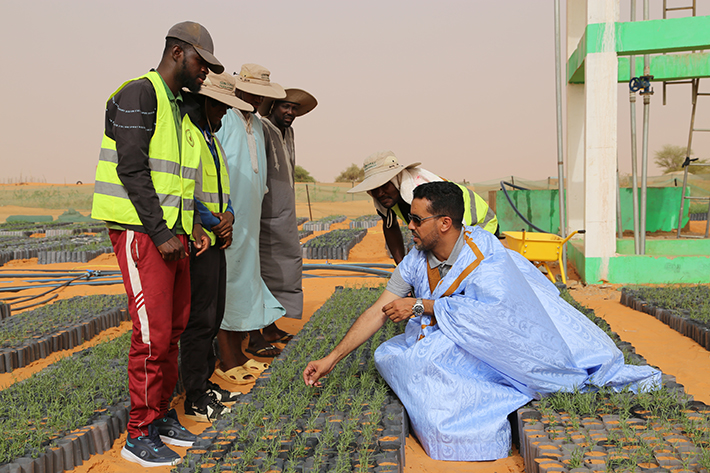
Local workers take part in a training session on planting techniques at the China-Africa Green Technology Park in Bir El Barka, Trarza region, Mauritania, on 22 May 2025 (XINHUA)
Building local capacity
Beyond equipment and infrastructure, the project places strong emphasis on knowledge transfer and local capacity building.
During the construction phase, the technical workforce consisted entirely of young Mauritanians, including university graduates. The Chinese team provided systematic training, turning the construction process into an opportunity for hands-on learning. Eighteen Mauritanian workers participated in this phase, and six were later selected to manage the park’s daily operations.
According to Tourad Medou, Mauritanian project coordinator and official responsible for promoting international ecological cooperation at the Ministry of Environment and Sustainable Development, many young people who previously depended on livestock farming have now learned how to operate water pumps, adjust drip irrigation systems and monitor plant growth.
Laghdaf also noted that the project had trained 45 local technicians in accelerated reforestation techniques and created 120 direct jobs for surrounding communities. A new generation of workers specialising in green industries is emerging in the desert.
For African partners, the cooperation is therefore not simply a technical intervention. It is designed to strengthen local capabilities and ensure that the benefits of the project can continue over the long term.
Building on the results of the China-Africa Green Technology Park, China and Mauritania have entered a new phase of cooperation. In December 2024, the two sides signed a memorandum on a 10,000-hectare carbon-sink forest project aimed at restoring degraded land and enhancing carbon sequestration.
As part of this new initiative, an experimental area of about 20 mu (approximately 1.3 hectares) was established to test planting techniques and management approaches before large-scale implementation. Mauritanian officials said the early results demonstrated the potential of Chinese technologies for restoring desertified land in Africa. The next step will focus on reducing costs and improving efficiency through mechanisation and stronger cooperation with local communities.
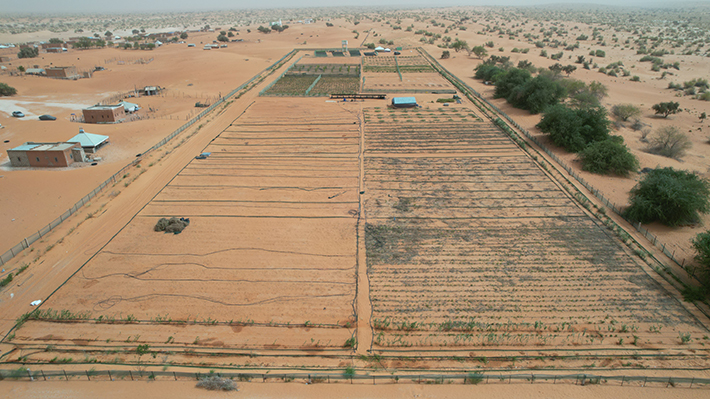
An aerial view shows the China Africa Green Technology Park in Bir El Barka, Trarza region, Mauritania, on 22 May 2025 (XINHUA)
Adapting solutions to local realities
The experience in Mauritania is part of a broader effort: the Great Green Wall Initiative for Africa, launched in 2007 to combat land degradation in the Sahel while improving local livelihoods. According to a United Nations report published in September 2020, nearly 20 million hectares of land had been restored and 120,000 jobs created through related agricultural activities after more than a decade of efforts. However, significant challenges remain before the initiative can reach its 2030 targets.
Lei Jiaqiang, researcher at XIEG, said climate change, population pressure and a lack of suitable technical solutions continue to hinder progress. Yet he believes China’s experience demonstrates that the trend of desertification can be reversed.
Over recent decades, China has curbed desertification through a series of major ecological programmes. These experiences now provide a reference point that China seeks to share with its African partners.
Rather than applying a single model everywhere, China’s cooperation with African countries focuses on adapting solutions to local conditions. In Mauritania, Chinese teams are working to control moving dunes while introducing water-saving irrigation technologies and selecting plant species that can improve both the environment and local livelihoods.
In Nigeria, cooperation focuses mainly on preventing wind erosion. In Ethiopia, efforts centre on restoring degraded grasslands. Chinese researchers there removed invasive shrubs, reused the vegetation to build fences and introduced a system combining land protection with rotational grazing. After only four months, grassland biomass had tripled, demonstrating the effectiveness of this locally adapted approach.
From the deserts of Mauritania to Ethiopia’s pastoral areas, these experiences show that cooperation based on science, training and local adaptation can open new paths for restoring degraded land, promoting economic development and improving living conditions across Africa.
| About Us | Contact Us | Advertise with Us | Subscribe |
| Copyright Beijing Review All rights reserved 京ICP备08005356号-5 京公网安备110102005860号 |


