| ChinAfrica |
| An Enduring Journey |
| The essence and vitality of the Long March are seen in China every day |
| By Mark H. Levine | VOL. 18 October 2026 ·2026-10-08 |

Visitors flock to see the immersive production The Great Expedition at the Guizhou Long March-themed Digital Art and Science Museum in Guiyang, Guizhou Province (CNS)
I first heard of the Long March in the 1960s, as a college student in the US. Like many Westerners, at the time I understood it as a distant, heroic tale from China’s past – a military relocation transformed into legendary status. It was only after reading Edgar Snow’s Red Star Over China in the mid-1970s that I began to grasp its deeper meaning: not merely a story of survival, but a testament to endurance, collective sacrifice and unwavering belief in the face of impossible odds.
By 1976, I had earned my PhD in sociology. Yet instead of pursuing an academic career, I spent the next three decades as a full-time volunteer labour organiser in impoverished American communities. It was during that period that I read Snow’s vivid account of the Long March, which left a lasting impression on me. At the time, I saw the Long March as a glorious chapter in Chinese history: an arduous journey defined by perseverance, extraordinary courage and an unshakable faith forged through extreme hardship.
Today, after more than two decades living in China, observing the country’s dramatic transformations, speaking with people from remote villages to modern cities and visiting revolutionary sites such as Zunyi in Guizhou Province and Xibaipo in Hebei Province, I have developed a far richer and more personal understanding of the Long March spirit. In my early days in China, I composed my first Chinese-themed song Huai’an – Promise of the Future (Huai’an in Jiangsu Province is the birthplace of Zhou Enlai, the first premier of the People’s Republic of China), inspired by the tangible progress I witnessed while living and travelling across the country.
The Long March is clearly not a closed chapter of history. From the tremendous changes I have witnessed, I see it as a living, evolving spirit for the new era. It carries lasting value and global significance – a modern Long March spirit that I have experienced firsthand during my many years in China.
A journey of survival
The Long March (1934-1936), undertaken by the Chinese Workers’ and Peasants’ Red Army and led by the Communist Party of China, was a journey of survival and hope. Facing harsh natural environments, rugged terrain and constant military suppression, China’s revolutionary leaders chose faith over despair, unity over division and the common good over personal gain. As Chairman Mao Zedong wrote in his 1938 treatise On Protracted War, victory would not come quickly, but it would surely come.
For a long time, Western narratives have treated the Long March as a historic event belonging only to museums, an outdated relic of revolutionary romance. What they have overlooked, however, is its universal spirit: courage in the face of adversity, resilience amid relentless challenges and commitment to shared progress over personal gain. My time in China has demonstrated to me that this spirit has never faded. It has simply taken on new meaning and adapted to the needs and dreams of the new era.
I have seen the new Long March spirit in China’s most remote corners. In western China, villages once isolated by treacherous terrain and entrenched poverty are being rejuvenated, not by dramatic interventions, but by the persistent, grinding work of local people. Village teachers crossing rivers to reach a handful of students. Engineers building roads through mountains one metre at a time. Health care workers carrying medicine to communities that have never seen a doctor. There are no grand battles or dramatic heroics here, but there are the same perseverance and selflessness that carried the Red Army across China 90 years earlier.
And I see it again today, as China navigates technological blockades and an uncertain global economy. Against this backdrop, China’s pursuit of independent innovation, green development and inclusive growth represents a new-era Long March of exploration and innovation.
Most importantly, the new Long March spirit has grown beyond the China story to become a valuable spiritual asset for the world. Its core values are universal: resilience in the face of hardship, unity in times of difficulty and dedication to long-term collective progress.
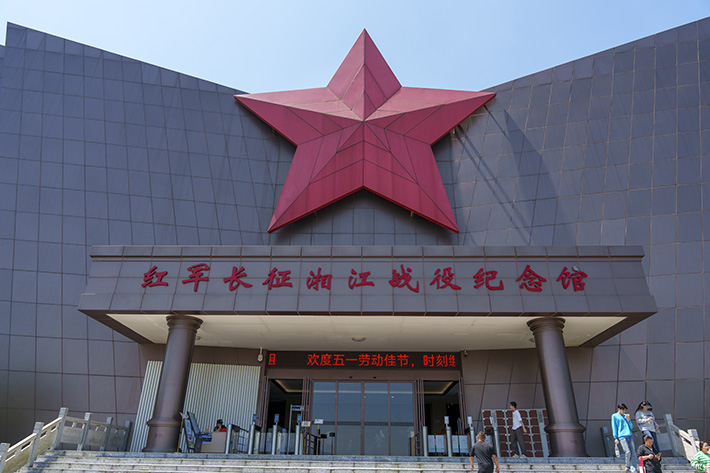
The memorial museum of the Xiangjiang River Battle, which took place during the Red Army’s Long March, in Guilin, Guangxi Zhuang Autonomous Region, on 4 May (VCG)
Dedication to progress
For nearly two decades, I have taught at Minzu University of China in Beijing, an institution dedicated to ethnic unity and educational equity.
My students mainly come from the high plateaus, deep mountains and borderlands of western and southwestern China. Many are from ethnic minority communities in regions that were, not long ago, as isolated and underdeveloped as the terrain the Long March once crossed.
They arrive at university barely out of adolescence, often speaking Mandarin as a second language, bearing the weight of their families’ expectations and economic reality. The academic pressure is immense. The cultural adjustment is harder. And yet they persevere.
They study not merely to escape their circumstances, but to return home as teachers, doctors, engineers and cultural stewards. They talk about revitalising their villages, preserving their languages and building bridges between their traditions and the modern world. This quiet dedication to collective progress and willingness to overcome personal hardship for the public good represents a youthful continuation of the Long March’s perseverance and communal spirit.
My own work has been shaped by this same ethos. As a songwriter, author and chief expert of the Telling China Stories Workshop, I have worked to break Western stereotypes that often reduce China’s development to superficial headlines and biased political narratives. Instead, I have focused on field research, grassroots interviews and real-life artistic creation. I have spent years travelling through inland provinces, ethnic autonomous regions and former poverty-stricken rural areas. I have sat with farmers, village teachers, civil servants, artisans keeping intangible cultural heritage alive and young community workers. I have learned their untold stories: years of persistent infrastructure building, the revival of fading ethnic traditions and steady efforts to help villages overcome backwardness.
I share these stories with global audiences because I believe the world needs to hear them – not as propaganda, but as human testimony.
Through my teaching and cross-cultural work, I have come to deeply understand that this spirit rejects stagnation and embraces continuous renewal. Western views once fixed the Long March as a distant, static historical story. But my years of immersive experience prove otherwise. It is a living force, visible in the social responsibility of my students, the resilience of rural communities I have documented and the courage of innovators pushing against technological barriers.
That spirit is not China’s alone. It belongs to anyone who has ever faced an impossible journey and kept moving forward.
The author is chief expert of Telling China Stories Workshop, School of Foreign Studies, Minzu University of China
|
||||||
| About Us | Contact Us | Advertise with Us | Subscribe |
| Copyright Beijing Review All rights reserved 京ICP备08005356号-5 京公网安备110102005860号 |


