| ChinAfrica |
| Science for Better Harvests |
| China’s Science and Technology Backyard model turns agricultural research into practical solutions for smallholders in Malawi |
| By Edwin Nyirongo | VOL. 18 October 2026 ·2026-10-10 |
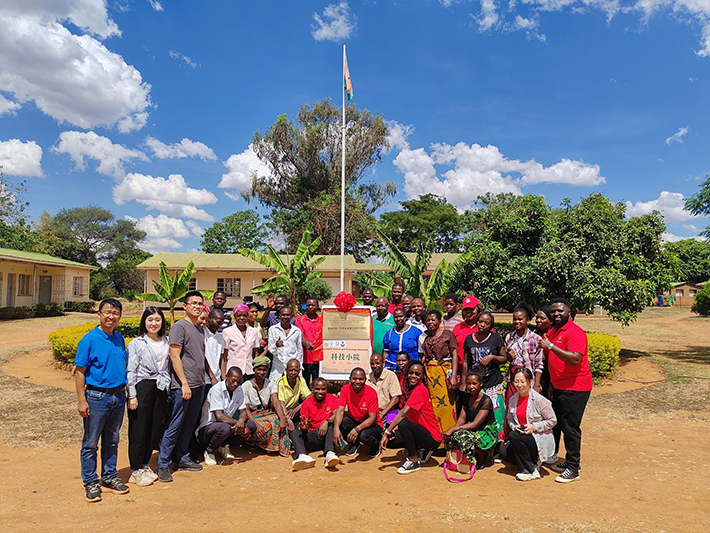
Teachers and students from China Agricultural University pose for a group photo with local farmers following the opening ceremony of the Lisasadzi Science and Technology Backyard programme in Kasungu District, Malawi, on 7 November 2023 (CHINA AGRICULTURAL UNIVERSITY)
Thirty-nine-year-old Malawian farmer Rabson Katsilizika has little reason to fear hunger today. His farm provides enough for his family, while also generating income to meet other needs.
Katsilizika, who farms in Traditional Authority Kaomba in Kasungu District in Malawi’s Central Region, grows a variety of crops, including staple maize, soybeans, beans and potatoes.
When he began farming full time in 2004 on a 2.5-hectare plot, however, the challenges came thick and fast, resulting in disappointing yields.
“The land was big enough, but the yield was low, meaning we often went hungry,” he said. “It became normal for my children to be expelled from school because of unpaid fees. And when they came home, there was nothing to eat because of a lack of food.”
Many other farmers in the region faced similar difficulties, struggling to feed and educate their children on limited incomes.
Relief came in the form of a Chinese agricultural innovation model called the Science and Technology Backyard (STB). Pioneered by China Agricultural University in partnership with African universities, the model is a platform for advancing China-Africa agricultural cooperation and supporting green agricultural transformation.
Addressing challenges
The STB model combines classroom instruction, field practice, technological innovation, social service and research to develop agricultural professionals able to address rural challenges. By connecting university laboratories with farmland, the model bridges the gaps between research and teaching, scholars and farmers, and academic theory and practical needs.
In Malawi, selected students study for three-year master’s degrees in China. Each student is paired with a Chinese STB mentor for methodological training and guidance on technology. The students then lead local adaptation and application.
During their first year, students study crop production, soil fertility, green agricultural development, agricultural economics and extension systems, alongside research methods and cross-cultural communication.
Students participate in the Chinese STB programme alongside other graduate students, conducting farmer surveys, field trials, technology demonstrations and training.
The objective is to identify problems through research and translate findings into solutions.
Under joint Chinese and Malawian supervision, students map local production challenges, including soil constraints, climate risks and input shortages. Rather than copying Chinese technologies wholesale, they adapt the principles behind China’s experience to Malawi’s circumstances.
In their second year, students return home to live and work at newly established local STBs, applying the knowledge gained in China to support farmers.
The Malawian STBs are located in Mulanje, Kasungu and Mzuzu, according to Samson Mofolo. Mofolo is a crop officer at Malawi’s Ministry of Agriculture and a PhD student at China Agricultural University.
STB students conduct household and field surveys, soil tests and crop-yield measurements to identify productivity bottlenecks and improve farm profitability.
“We look at low soil fertility, inadequate nutrient application, suboptimal planting density, weak pest management and limited access to extension services. This translates challenges reported by farmers into testable research questions,” Mofolo said.
Driving change
Students identify lead farmers, youth extension champions and community influencers to promote peer-to-peer learning and scaling from farmer to farmer and from village to village.
They also work with universities, agricultural departments, extension agencies, input suppliers, agribusinesses and farmer organisations to tackle barriers to adoption and build a self-sustaining STB network.
Mofolo said improving crop productivity remains the programme’s main objective.
For farmers such as Esnart Mwela, the results are visible. She said that previously, they planted in furrows 90 cm apart but, through the STB programme, had learned to reduce the spacing to 60 cm to improve efficiency and yields.
Because fertilisers are expensive, farmers have also been taught to produce lower-cost organic fertiliser.
“We mix [maize] husks with manure and three buckets of water, then after storing this mixture in plastic containers for three weeks, it is mixed with only 10 kg of organic fertiliser to produce over 50 kg of fertiliser. It could then cover larger areas of farmland,” she said.
“We were also taught many [other] things, including pest control. But what is key to all this is the mindset of accepting change, because these things are new to us,” Mwela said, adding that the changes had improved her yields and enabled her to feed her children and pay their school fees.
Katsilizika has also benefitted from the programme. He said advice on using certified seeds had helped improve his productivity.
“In the past, we would select some of the maize we had harvested and use the seeds to replant the following season. However, we have been shown that planting certified seeds helps improve productivity,” he said. “Planting different crops on the same field also increases yields.”
Agriculture is central to livelihoods in Malawi, where more than 80 percent of Malawians depend on it for food and income, according to the World Bank.
For farmers like Katsilizika, the STB model is helping turn scientific knowledge into solutions, and solutions into more productive livelihoods.
|
||||||||||||
| About Us | Contact Us | Advertise with Us | Subscribe |
| Copyright Beijing Review All rights reserved 京ICP备08005356号-5 京公网安备110102005860号 |


