| ChinAfrica |
| Growing with the Land |
| A decade after taking over one of Africa’s biggest copper-cobalt mines, a Chinese company has built a record beyond its production numbers |
| By Xie Hao and Li Lijin | VOL. 18 October 2026 ·2026-10-15 |
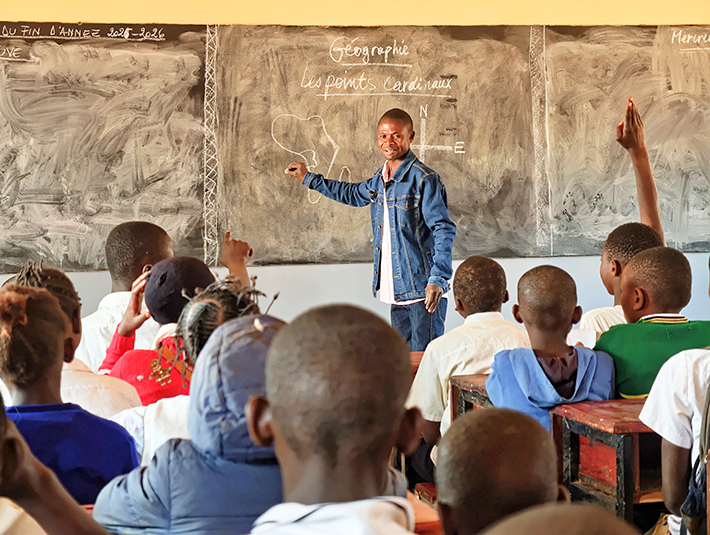
A class at Mukaka Primary School (COURTESY)
A map of the villages around Fungurume hangs on the wall of Gérard Kamiji Lwendela office at the TFM mine camp in southern Democratic Republic of the Congo (DRC). He is rarely there long enough to look at it.
More often he is on a village footpath, or sitting under the big tree at the entrance to a settlement. Word of his arrival travels fast enough that plastic chairs and wooden stools appear before he does.
Elders sit at the front. Children peer in from behind. Lwendela listens to one issue after another – a well that needs fixing, a road washed out by the last rains – and writes each into a notebook already dense with entries from villages before this one.
Lwendela is community liaison coordinator at Tenke Fungurume Mining (TFM), a post the mine created as part of its formal engagement with villages around it.
“Liaise, listen, mediate,” he said, summing up 18 years on the job in three words.
TFM, named for the two towns anchoring its concession, produced its first cathode copper in 2009. In 2016, CMOC Group Limited, a mining company that traces its roots to Luoyang, Henan Province, and is now headquartered in Shanghai, took over the project from US-based Freeport-McMoRan. It later developed a second mine nearby, Kisanfu Mining (KFM). This year marks a decade since the Chinese team took charge of TFM.
Under the DRC’s mining code, large operators are required to sign social responsibility agreements with the communities around their sites. TFM’s current agreement, signed in 2021, committed the company to more than $31 million over five years. CMOC said it has invested a cumulative $325 million in community projects since operations began.
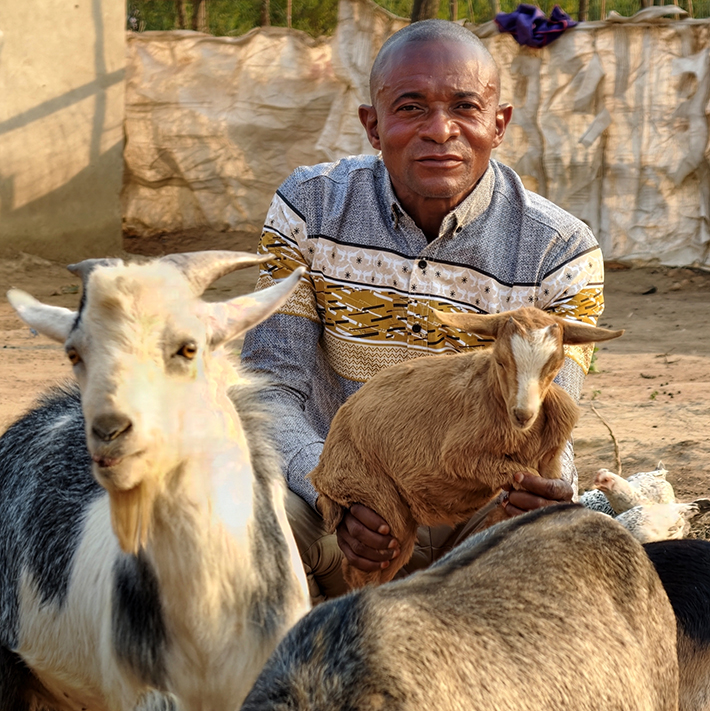
Stanley Marangani Lufanga, from the town of Tenke, with his goats (COURTESY)
New livelihoods, new standing
Stanley Marangani Lufanga, from the town of Tenke, is the father of 10 children. He has also become known locally for his goats.
He joined TFM’s livestock support programme with a starter herd of five does and two bucks. TFM agronomists visited regularly, walking him through breeding and disease prevention; when a goat fell sick, he said, his first instinct was still to call them.
The herd grew faster than expected. Seven goats became 38 within 20 months. After selling some and repaying his loan to the programme, 18 remained, along with roughly $600, enough for his children’s school fees and a new brick house, one room of which is set aside for the goats. He said he sometimes sleeps in there with them, in case someone tries to steal the herd overnight.
Traditional chief Mwanga Kivula Bwanikwa has benefitted from TFM’s agricultural support since 2008. The 2021 agreement cut his maize loan repayment from 556 buckets per hectare to 200, leaving him more of his own harvest to keep or sell. He now urges other village chiefs to follow the agronomists’ advice.
At one of TFM’s water retention facilities, Agathe Mikombe is the only woman among dozens of workers on site. She inspects the geomembrane liner that separates the mine’s wastewater from the groundwater and surrounding vegetation – a tear invisible to an untrained eye can lead to a leak that may go undetected for months.
Eight years into the role, she said the hardest part was never the technical work. It was earning the authority to direct a crew of men in a trade where women were not expected to be in charge. The salary has since allowed her to put her children through school and build a house of her own.
Not far away, Christelle Lwaba works on another part of TFM’s environmental footprint: water treatment. A long-time specialist at the mine’s wastewater treatment facilities, she has also trained employees and local communities in water-treatment practices. In February, she received an AWIMA Leadership Award for community development and social impact. She is also a co-founder of the Women in Science Network, which encourages young Congolese women to pursue careers in science and engineering.
According to CMOC’s 2025 annual report, TFM passed a re-audit confirming that it meets all 32 criteria of the Copper Mark, an international standard for responsible copper production, and the company also published its first climate-related financial disclosure report last year.
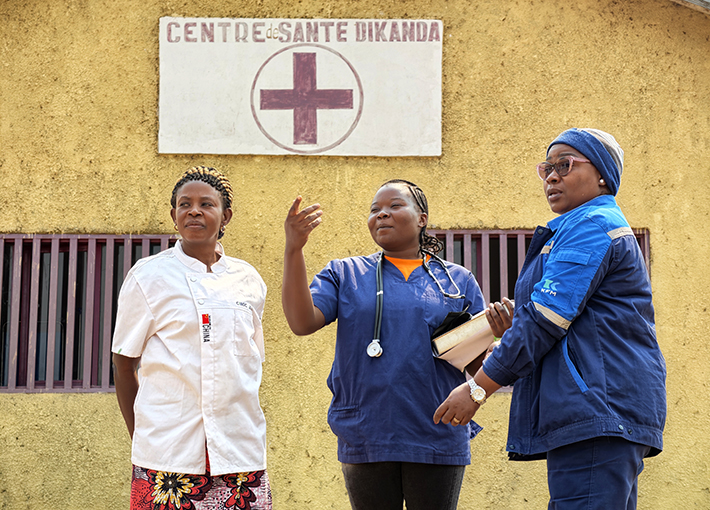
A KFM community liaison coordinator (right) at Dikanda Health Centre (COURTESY)
What a generation inherits
Nineteen-year-old Makuya grew up in Fungurume and now studies more than 10,000 km away at Central South University in Changsha. She attended a TFM-funded community school as a child, won a scholarship in secondary school while topping her class in mining and quarrying, then came to China through CMOC’s “100 Mining Talents” programme, which sends local students abroad for full degrees.
Asked about the years ahead, she said she hoped to “first become the light of my family, then of my community, then of Congolese women in mining.”
At the Dikanda Health Centre near KFM, midwife Marie has worked in this part of Katanga for more than 20 years. She remembers when the only nearby option was a single private clinic and most women gave birth at home.
A new centre, funded and completed by KFM in 2025, changed that, with treatment rooms, a laboratory, an obstetrics ward, 20 beds and 10 medical staff. It gives the community something close to a functioning clinic for the first time in living memory. “Some of them, I saved,” Marie said of the mothers she has treated there.
TFM’s community fund has helped build or renovate close to 20 schools around Fungurume since operations began, alongside wells, roads and health posts funded through its social responsibility agreements. CMOC’s 2025 annual report put net profit attributable to shareholders at 20.34 billion yuan ($2.86 billion), up 50.3 percent from a year earlier, as higher prices for its main products and strong production and sales volumes lifted earnings. Copper output reached a record 741,100 tonnes, driven in part by continued production gains at TFM and KFM.
Albert, an electrician who has worked at TFM for 18 years, describes the mine’s growth in practical terms: new production lines, more equipment, more staff.
“The mine has grown,” he said. “And now my children have a chance to work here too.”
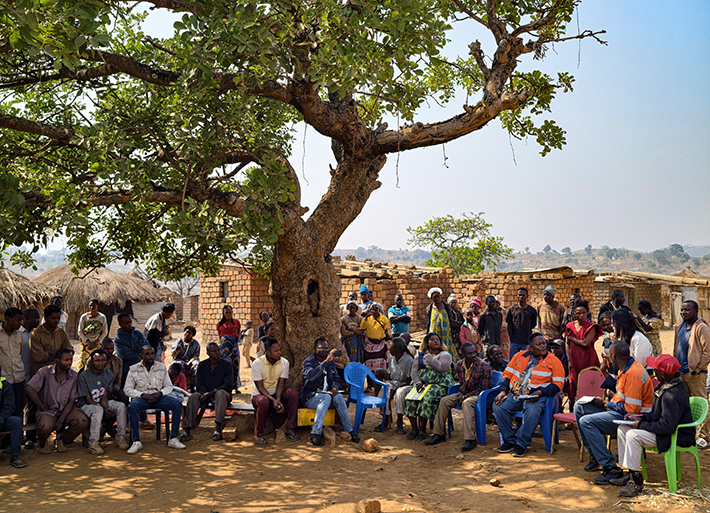
CMOC staff meet with villagers(COURTESY)
| About Us | Contact Us | Advertise with Us | Subscribe |
| Copyright Beijing Review All rights reserved 京ICP备08005356号-5 京公网安备110102005860号 |


