| ChinAfrica |
| Culture Builds Bridges |
| People-to-people exchanges deepen friendship and understanding between China and Africa |
| By YORO DIALLO | VOL. 18 November 2026 ·2026-11-03 |
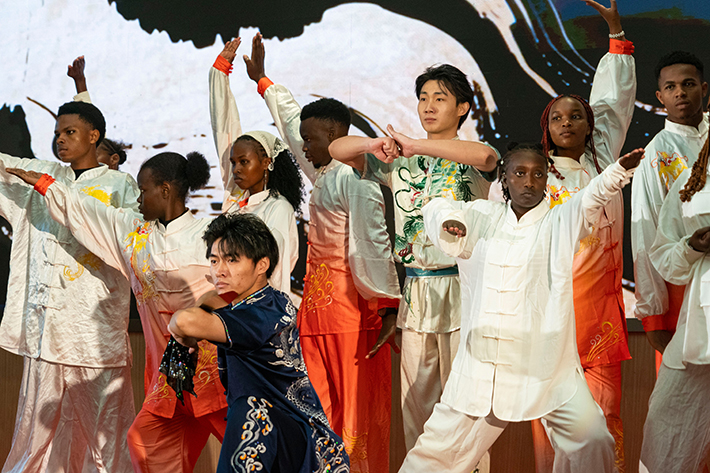
Actors perform at the opening ceremony of the Hunan Film Week in Nairobi, Kenya, on 9 June (XINHUA)
The 2026 China-Africa Year of People-to-People Exchanges provides us with an opportunity to revisit the history of relations between China and Africa. The rich cultures of China and Africa have never developed solely within their respective borders. As maritime navigation has developed over the past millennia, Chinese and African cultures have come into contact through trade and people-to-people exchanges, spreading across the globe and contributing to humanity’s cultural development.
The earliest exchanges between China and Africa date back to ancient times, with contacts developing over centuries through trade and maritime routes. During the Tang Dynasty (618-907), expanding maritime networks facilitated greater contact between China and regions beyond Asia. Chinese merchants traded goods such as porcelain and silk, while African products also reached China.
The Chinese explorer Wang Dayuan of Yuan Dynasty (1271-1368) arrived at Africa’s eastern coast. The travel accounts he produced marked a milestone in the history of maritime expeditions.
During the Ming Dynasty (1368-1644), the famous navigator Zheng He led several expeditions to the African continent. These voyages aimed to explore the continent, project Chinese imperial prestige and establish friendly relations with the regions visited.

Local people visit a stall to buy Chinese food at the Chinese New Year temple fair in Cape Town, South Africa, on 21 February (XINHUA)
A history of solidarity
In the 19th century, under pressure from foreign powers, China went through a difficult period, while Africa suffered under European colonial rule. This shared experience of foreign domination and humiliation shaped the common destiny of China and Africa.
In 1956, China and Egypt signed an agreement on cultural cooperation in Beijing. In 1959, Chairman Mao Zedong received a delegation of young people from Africa, Latin America and Asia, who were visiting China as part of cultural and people-to-people exchanges.
Since the founding of the People’s Republic of China in 1949, the country has pursued a policy of solidarity with African liberation movements under the leadership of the Communist Party of China.
In 1955, the Bandung Conference in Indonesia marked an important milestone in relations between China and Africa. It brought the spirit of South-South cooperation, based on solidarity among Third World countries, to the forefront of international affairs.
The period from the 1960s to the 1980s marked a turning point in political, diplomatic, cultural and people-to-people exchanges between China and Africa. True to its original commitment, China helped its African friends achieve political independence and embark on the long march towards economic independence. Flagship projects, including the Tanzania-Zambia Railway, were implemented.
The establishment of the Forum on China-Africa Cooperation in Beijing in 2000 provided an institutional framework for relations between China and African states and ushered in a new era of cooperation.
A few years later, China became Africa’s leading trading partner. Beyond the economic sphere, both sides placed great emphasis on cultural and people-to-people exchanges.
Tens of thousands of young Africans are pursuing their studies in China, thanks to scholarships offered by the Chinese government. Vocational and technical training programmes are also provided to Africans across a range of development fields.
Exchanges between Chinese and African media organisations and the training of journalists also contribute to greater mutual understanding.
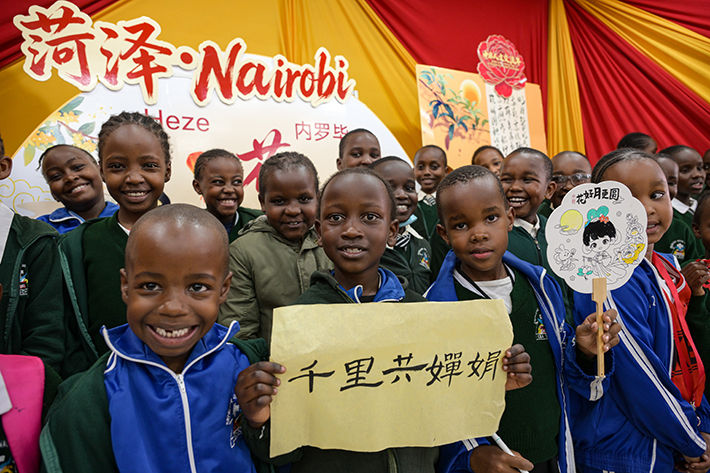
Children display their Chinese calligraphy and fan-painting works during an event to celebrate the upcoming Mid-Autumn Festival at the Confucius Institute at Kenyatta University in Nairobi, Kenya, on 16 September (XINHUA)
Growing bonds
Cultural exchanges are also intensifying through language learning. Confucius Institutes are being established at several African universities, and African languages are being taught in China. Chinese interest in African cultures is growing through art exhibitions and African cultural weeks organised in major Chinese cities. There is a growing African presence in China, particularly in Guangzhou and Yiwu, which now have vibrant African communities.
Exchanges between the two sides are actively contributing to the creation of a space for intercultural dialogue that is helping reshape relations between China and Africa in the context of multilateralism. Today, the celebration of the Chinese New Year in many African countries speaks volumes about the vigour of China-Africa cultural dialogue.
The Cultures in Focus programmes have become significant milestones in cultural exchanges between the two sides. Chinese and African cultures are showcased through the Chinese Culture in Focus and African Culture in Focus programmes. As part of African Culture in Focus, large-scale cultural events are organised in many Chinese cities. These events help strengthen mutual understanding and consolidate sincere, pragmatic friendship.
We are therefore firmly committed to the spirit of the statement made by Chinese President Xi Jinping at the Julius Nyerere International Convention Centre in Tanzania in March 2013: “We will place greater emphasis on people-to-people and cultural exchanges between China and Africa so as to improve mutual understanding and perception and expand public support for the China-Africa friendship. To develop China-Africa relations is a cause geared towards the future, which calls for unremitting efforts of youths from generation to generation. Both sides should vigorously promote youth exchanges so that China-Africa friendship will be carried forward and remain full of vigour and vitality.” With Chinese and African people joining forces in the new millennium, the cultural exchanges between China and Africa promise to flourish further.
In light of the tensions prevailing on the international stage, Chinese and African peoples must draw on the wisdom that characterises these two civilisations, both dating back thousands of years, to bring their peoples closer together.
In this context, my participation as a jury member for the 2026 Orchid Awards offered a particularly interesting opportunity to examine the cultural and human dimensions of China-Africa relations. Through the candidates’ journeys, I have come to appreciate the extent to which culture can build bridges between civilisations. These individual stories show that relations between civilisations are not shaped solely by state institutions. They are also forged by individuals who, through their commitment, become bridges between cultures. The Orchid Awards shine a light on these individuals, demonstrating that culture is one of the human foundations of international relations. Behind every cultural journey lies a person who has chosen to cross geographical, linguistic and cultural boundaries to engage with other cultures.
In a world where peoples are increasingly interconnected, exchanges between China and Africa provide a dynamic platform for dialogue that brings together different civilisations and cultures.
The author is director of Centre for Francophone Studies, Institute of African Studies, Zhejiang Normal University
| About Us | Contact Us | Advertise with Us | Subscribe |
| Copyright Beijing Review All rights reserved 京ICP备08005356号-5 京公网安备110102005860号 |


