| ChinAfrica |
| Sci-Tech Services on the Ascent |
| China’s science and technology services sector enters a new phase of growth |
| By Hu Fan | VOL. 18 May 2026 ·2026-05-07 |
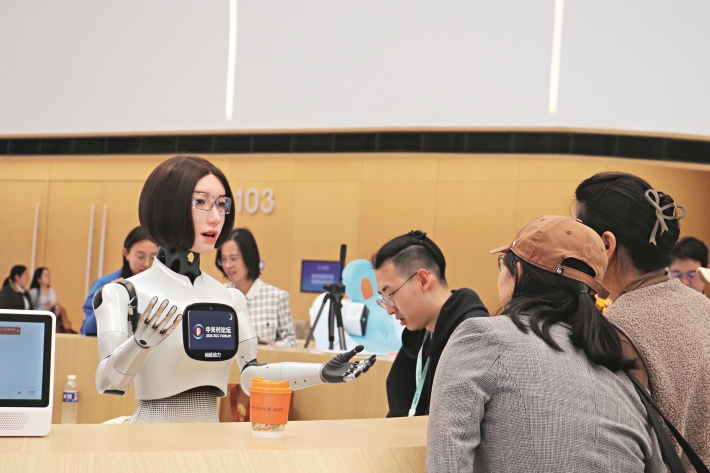
Visitors interact with a humanoid robot at the 2026 Zhongguancun Forum Annual Conference in Beijing on 25 March (HU FAN)
More than 1,000 participants from over 100 countries and regions exchanged views and insights on topics related to the “deep integration of technological and industrial innovation” at the Zhongguancun Forum Annual Conference held in Beijing from 25 to 29 March.
The conference once again placed frontier technologies such as quantum science, embodied intelligence and 6G in the global spotlight. Beyond these headline-grabbing innovations, however, another development quietly signalled a structural shift in China’s innovation landscape.
For the first time, the forum featured a parallel session dedicated to the high-quality development of the science and technology services industry, highlighting an industry long working behind the scenes as a powerful driver of economic growth.
Often overshadowed by manufacturing and high-tech breakthroughs, the science and technology services sector is now emerging as a vital connector across the innovation ecosystem. It encompasses a wide range of activities, including research and development, technology transfer, business incubation, inspection, certification, intellectual property services, science and technology finance and consultancy. In essence, it serves as the bridge linking scientific discovery with industrial application, enabling the efficient flow of technology, capital, talent and data.
The industry has already reached a substantial scale. Five of its sub-sectors - such as information technology research and development and technology promotion - have each surpassed the trillion-yuan ($146.6 billion) mark, while each of the four others, including technology transfer and testing and certification, is valued in the hundreds of billions. In 2025, the total value of technology contracts nationwide reached 7.6 trillion yuan ($1.1 trillion), reflecting steady growth in the commercialisation of scientific achievements.
Beijing provides a clear illustration of this growth trajectory. In 2025, revenue of the city’s major science and technology services enterprises exceeded 1 trillion yuan ($146.6 billion), with the sector contributing 384.2 billion yuan ($56.35 billion) in added value, accounting for 7.4 percent of the city’s GDP. The value of technology contracts in Beijing alone reached 986.5 billion yuan ($144.7 billion), the highest nationwide. These figures underscore the industry’s evolution into a pillar of the urban economy.
Li Daokui, director of the Academic Centre for Chinese Economic Practice and Thinking at Tsinghua University, described the sector as “a key link connecting technological innovation with industrial upgrading.” In his view, its development is essential for achieving the goals set out in China’s 15th Five-Year Plan (2026-2030), particularly the push towards greater self-reliance in high-level science and technology.
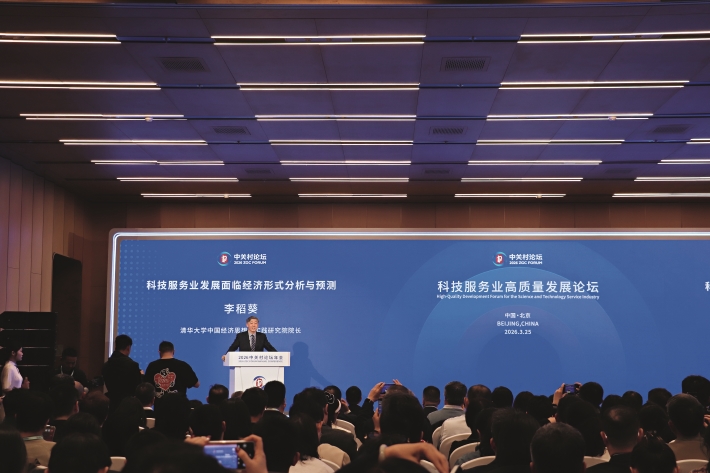
A parallel forum on the high-quality development of the science and technology services industry during the 2026 Zhongguancun Forum Annual Conference in Beijing on 25 March (HU FAN)
Policy momentum builds
The rise of the science and technology services industry is not occurring in isolation; it is being actively supported at the national level. In May 2025, nine government departments, led by the Ministry of Industry and Information Technology, jointly issued guidelines to accelerate high-quality development of the sector. The policy framework emphasises innovation-driven growth, market orientation, integrated development and quality enhancement, aiming to expand the industry’s scale while boosting its efficiency and impact.
At the forum, Du Guangda, a senior official from the ministry, identified four priority areas for future work: fostering specialised, market-oriented service institutions, strengthening talent development systems, building high-level service platforms to consolidate innovation resources, and enhancing the overall ecosystem to support sustainable growth.
These priorities outline a clear roadmap for the industry’s shift from rapid expansion to quality-driven development. Standardisation is a critical component of this process. According to the ministry, China plans to issue at least 40 national and industry standards for the science and technology services sector by 2027, and more than 80 by 2030. This effort addresses the growing need to regulate emerging business models, such as digital incubation and “one-person companies,” which are not yet fully covered by existing frameworks.
Another key objective is the creation of a unified national technology market. Initiatives are underway to establish a standardised platform for technology transactions, enhance the registration and management of technology contracts, and promote reforms in the market-oriented allocation of technological resources. The scale of activity is already impressive: in 2025, more than 1.04 million technology contracts were registered nationwide.
To accelerate the commercialisation of research outcomes, local governments and institutions are experimenting with innovative approaches. One notable example is the “use first, pay later” model, under which universities and research institutes allow enterprises to access technological outcomes with minimal upfront cost, with payments deferred or linked to future revenues. This model helps to address the financing constraints faced by small and medium-sized enterprises, lowers barriers to technology adoption, and speeds the transition from laboratory to market.
Talent is another critical component of this ecosystem. Technology transfer requires professionals who understand both science and business, a combination historically in short supply. Beijing has taken the lead by introducing a professional title system for technology brokers, certifying nearly 1,000 individuals to date. Universities have also expanded efforts to train specialists in technology transfer, while thousands more have received professional development as technology managers. Together, these initiatives are helping to cultivate a more skilled and professional workforce to support the sector’s continued expansion.
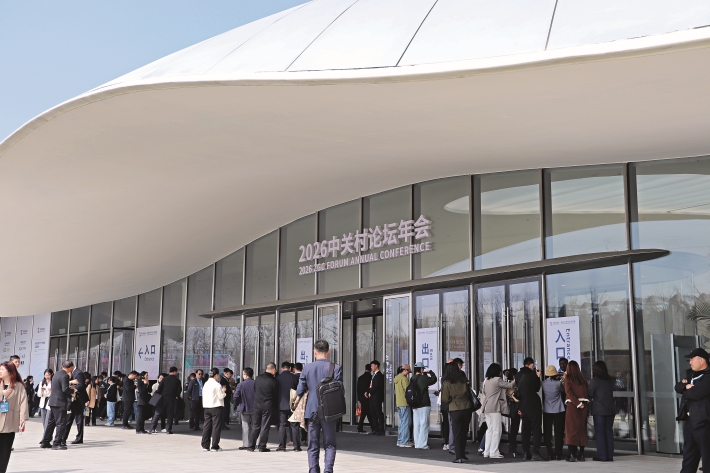
People gather for the 2026 Zhongguancun Forum Annual Conference in Beijing on 25 March (HU FAN)
AI reshapes the sector
If policy provides the foundation, digitalisation, especially artificial intelligence (AI), is rapidly reshaping the future of the industry. At the forum, an action initiative on high-quality development emphasised the need for deeper integration of digital and intelligent technologies throughout the entire science and technology services value chain. The goal is to create a new paradigm of “AI-powered science and technology services,” delivering solutions that are more precise, efficient, and impactful for the real economy.
The impact of AI is already tangible. From research and design to technology transfer, and from testing and certification to incubation and acceleration, intelligent systems are not only enhancing efficiency, but also enabling innovative business models.
Entrepreneurship platform Dark Horse, for instance, has developed AI-driven tools to match technology firms with relevant government policies, helping companies to identify support measures more effectively. It has also built global communities connecting young scientists with enterprises, and launched intelligent matching systems for entrepreneurs and investment.
Meanwhile, Beijing-based lab solutions provider Dinaflow has attracted attention with its lights-out laboratories - fully AI-driven experimental environments capable of self-optimisation and continuous learning. Compared with traditional automated laboratories, these systems can conduct multiple experiments simultaneously, correct errors in real time and improve efficiency.
These examples highlight how AI is reshaping how science and technology services are delivered and scaled.
Looking ahead
Despite its rapid growth, China’s science and technology services industry remains in an emerging stage, particularly in a global context. As a result, internationalisation has become a key driver of its development.
Jia Kang, a researcher at the Chinese Academy of Fiscal Sciences, noted that China’s science and technology services exports grew by 8.8 percent in 2024, with significant advances in areas such as AI and green energy. Nevertheless, challenges persist, including barriers to the flow of key resources, gaps in innovation capacity, and limited influence in shaping international standards.
To address these issues, Jia argues that China must shift from a factor-based approach to institutional opening, aligning more closely with global standards in regulation, governance and management. Achieving this will require deeper reforms, enhanced facilitation of cross-border flows, strengthened domestic innovation capabilities, and more robust policy support systems.
For Li, the future of the industry hinges on coordinated efforts at multiple levels. The central government must provide clear strategic guidance, while local governments should cultivate supportive environments that allow them to benefit from the industry’s spillover effects. Enterprises, in turn, require incentives and institutional support to innovate and collaborate effectively. Industry associations, he adds, can help by addressing practical challenges.
As China moves into its next stage of development, the science and technology services industry is set to assume an increasingly central role. No longer a supporting player, it is emerging as a key engine driving the integration of innovation and industry.
|
||||||||||||
| About Us | Contact Us | Advertise with Us | Subscribe |
| Copyright Beijing Review All rights reserved 京ICP备08005356号-5 京公网安备110102005860号 |


