| Current Cover Story |
| From Long March to Long Road |
| Understanding China’s struggle for modernisation and its implications for Africa |
| By Charles Onunaiju | VOL. 18 October 2026 ·2026-10-08 |
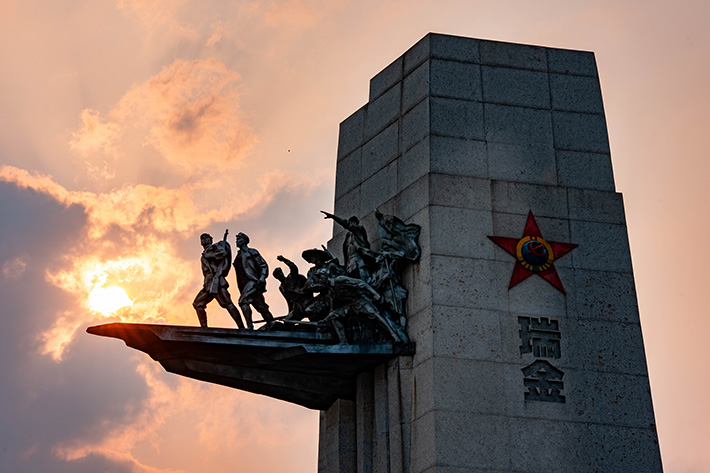
A Long March-themed sculpture in Ruijin, Jiangxi Province, the starting point of the Long March by the First Front Army (also known as the Central Red Army) of the Chinese Workers’ and Peasants’ Red Army (VCG)
It was one of the most severe tests of human endurance and will in modern history. The Long March of the Red Army led by the Communist Party of China (CPC) in the 1930s was an extraordinary feat and a heroic epic of collective struggle in China’s revolutionary history.
Crossing mountain ranges rising more than 4,500 metres above sea level, navigating narrow mountain paths and steep climbs, crossing 24 rivers and traversing 11 provinces amid pitched battles and continual skirmishes with pursuing Kuomintang forces, the Red Army’s survival was a remarkable testament to its dedication, perseverance and courage.
A symbol of years of hardship and a harbinger of a triumphant future, the Long March can in many ways be seen as the beginning of China’s long journey towards national modernisation and development. Although that journey has acquired new dimensions in contemporary China, the legacy of persistence, endurance and determination associated with the Long March continues to resonate.
An unprecedented undertaking
Mao Zedong, whose leadership became increasingly prominent during the Long March, described it as an unprecedented undertaking. The Red Army endured aerial reconnaissance and bombardment, encirclement, pursuit and interception by forces numbering hundreds of thousands, while covering more than 10,000 km.
The Long March began as a strategic retreat following the failure of earlier military strategies, many influenced by foreign military models, to break the Kuomintang’s fifth encirclement campaign against the CPC-led Central Soviet Area. What initially appeared to be a military withdrawal evolved into a strategic movement that fundamentally altered the course of the Chinese revolution.
The Zunyi Conference in southwest China’s Guizhou Province in January 1935 marked a crucial turning point in the history of the CPC and the Chinese revolution. The conference reassessed military and political strategies influenced by European revolutionary experience and found them inadequate to China’s particular circumstances.
On the 80th anniversary of the victory of the Long March in 2016, Chinese President Xi Jinping described it as a great expedition to seek ideals and faith, test truth and break new ground. He emphasised integrating Marxism-Leninism with China’s actual conditions to address practical problems.
The lessons of the Long March have subsequently been incorporated into the CPC’s understanding of revolution, reconstruction, reform and modernisation. Xi has identified seeking truth from facts and strict self-discipline as among the defining elements of the Long March spirit. In contemporary China, this spirit of resolve and perseverance continues to be invoked in the pursuit of national development and rejuvenation.
The Long March has therefore become more than a historical event. It has become a metaphor for sustained dedication to national development. CPC members are encouraged to regard their contributions as part of an ongoing journey requiring commitment and service to the people.
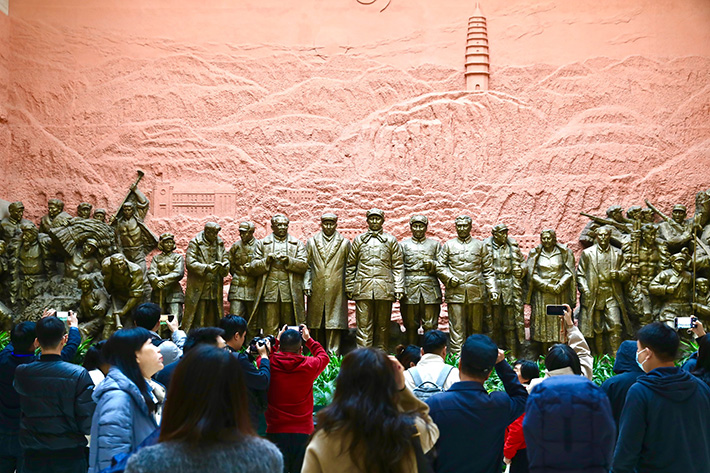
Visitors walk through the Yan’an Revolutionary Memorial Hall in Shaanxi Province on 20 October 2024 (CNS)
A shared road
The contemporary relevance of this spirit extends beyond China. At the 2024 Summit of the Forum on China-Africa Cooperation, Xi said that modernisation is an inalienable right of all countries. He also noted that China and Africa together account for around one-third of the world’s population and argued that global modernisation cannot be achieved without the modernisation of China and Africa.
For African countries, this idea resonates strongly with the continent’s own historical experience. Africa’s struggle against colonial domination was itself a long march towards freedom, marked by sacrifice, resistance and perseverance. Generations of young people, women and men gave their lives in struggles that ultimately paved the way for independence and the aspirations embodied in the African Union’s Agenda 2063: The Africa We Want.
China and Africa therefore share an important historical experience: the determination to pursue national development on their own terms while responding to changing international circumstances. Their respective journeys are different, but both have been shaped by the conviction that progress requires endurance, adaptability and responsiveness to actual conditions.
This perspective is particularly important amid growing geopolitical tensions and global uncertainty. Pressure on multilateral institutions, challenges to international law and increasing strategic competition have created a more difficult external environment for developing countries. For countries of the Global South, maintaining a clear path towards modernisation is becoming both more difficult and more necessary.
The enduring significance of the Long March lies precisely in this lesson. It demonstrates that even when the road ahead appears extraordinarily difficult, a viable path can be found through determination, adaptation and perseverance. The journey may involve setbacks, but these do not necessarily require abandoning the path.
The Long March ended in October 1936, but the journey it came to symbolise did not. Reform, development and modernisation are continuing processes, with every stage bringing new achievements and challenges. The spirit of the Long March calls for persistence in confronting each of them.
China-Africa cooperation draws strength from shared historical experiences, particularly the struggle against colonial domination and the pursuit of national development. The Long March remains a powerful part of China’s historical memory and offers a compelling metaphor for both sides’ determination to pursue modernisation according to their own circumstances.
Africa’s own long march to freedom was similarly marked by sacrifice and struggle. Generations of resistance fighters helped pave the way for independence. Today, China and Africa face the same challenge: transforming political independence into sustainable development, modernisation and national rejuvenation.
Their journeys will inevitably take different forms. Yet their shared commitment to determining their own paths, learning from historical experience and persevering through difficulties provides an important foundation for deeper cooperation. The Long March may belong to China’s revolutionary past, but its spirit of endurance and determination continues to offer lessons for the contemporary march towards modernisation in both China and Africa.
The author is director of Centre for China Studies, Abuja, Nigeria
| About Us | Contact Us | Advertise with Us | Subscribe |
| Copyright Beijing Review All rights reserved 京ICP备08005356号-5 京公网安备110102005860号 |


