|
||||||||||
| Home Top News Economy/Tech Culture/Sports China in Foreign Eyes Green Development Videos Intangible Cultural Heritages |
|
||||||||||
| Home Top News Economy/Tech Culture/Sports China in Foreign Eyes Green Development Videos Intangible Cultural Heritages |
| ChinAfrica |
| On Firmer Ground |
| Far from the relapse Western media predicted, Guizhou’s relocated families have finally found their footing |
| By Zachary Gordon Lundquist | VOL. 18 June 2026 ·2026-06-02 |
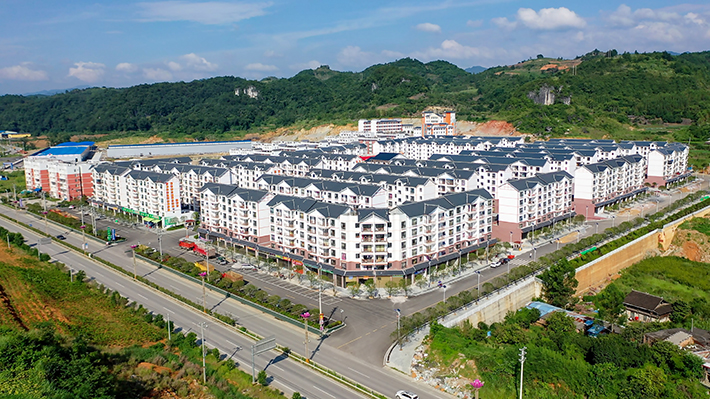
A relocation community in Congjiang County, Guizhou Province (WU XINGKE)
In February 2021, China announced the elimination of extreme poverty across the country. Seven counties in Guizhou Province were among the last to be lifted out of poverty. Entire villages in remote mountainous areas unsuitable for sustainable development were relocated by the government into apartment complexes in suburban areas.
Five years on, many Western media reports question whether the programme has succeeded, suggesting that many people have fallen back into poverty. To find out, I visited Congjiang and Rongjiang counties in southeast Guizhou to see whether those doubts held up.
What I found was more than statistics - a living picture of resilience, hope, culture and unexpected opportunity.
Art, enterprise and a new generation
In Rongjiang County, I met Wu Songtao, a resident at the Tehe Community relocation site and a fifth-generation inheritor of Dong ethnic embroidery, a craft known for its intricate animal and floral motifs. Before relocation, her family lived in the remote Piaozhai Village. “We could only grow a few vegetables to make a meagre living,” she told me. “Our traditional art, passed down from my mother, was dying.”
Then came the move. With the rise of the Guizhou Village Super League - a popular grassroots football event that drew visitors from across the country - Rongjiang County found itself at the centre of a tourism boom it had not anticipated. Wu’s skills were recognised, and she now works at the community’s Intangible Cultural Heritage Centre workshop, producing ethnic clothing, dolls, T-shirts and scarves featuring Village Super League motifs. During the 2023 finals, she earned over 8,000 yuan ($1,176) in a single day. Today she has trained over 70 women in Dong embroidery, turning a dying family tradition into a collective enterprise sold across China through livestreaming and online platforms.
For Ouyang Ban, the path was different. He grew up in Daxiu Village, a Zhuang ethnic community deep in the mountains of Congjiang County, walking three hours to school each day. His family of seven earned less than 10,000 yuan ($1,470) a year. In 2019, they voluntarily relocated to Yinxin Community, where his children now attend a school minutes from their front door. Rather than settle for city work, Ouyang started a passion fruit agricultural company with government support. His income has since grown from a few thousand yuan a year to several hundred thousand. He now employs university students, extending the benefits of relocation further.
For Huang Dehua, another Yinxin Community resident, the change was quieter but no less significant. His family had come from an isolated mountain village with barren land and poor transport links. After relocating, he founded Congjiang Huizhong Labour Service Co. Ltd., which helps other relocated residents to find steady local employment. So far, 60 people have found jobs through the company. But when I asked what had changed most for his family, he did not mention the company. He pointed to the wall of his living room, covered in academic awards his two children had earned since the move. “The quality of education here, along with improved living conditions, has greatly motivated my children to learn,” he said.

Tourists watch a Village Super League match in Rongjiang County, Guizhou Province, on 5 October 2025 (WEI GUIJIN)
More than a move
Wu Bangzhu is a mother from Rongjiang whose experience reflects that of many women who came through the relocation programme with young children and no clear path forward. After moving from the mountains, she tried selling fruit on the street while caring for her two young daughters. It was exhausting and unsustainable.
The turning point came when she was recruited to a Mother-Friendly Workshop - a small operation specialising in Dong embroidery and cultural products, designed specifically for women in her situation. The hours are flexible. Women can bring their children with them. Training is provided. She learned fast and has since risen to floor manager, overseeing orders and developing new product designs. “I not only earn a good salary,” she said, “but I get to help other women, including young wives and single mothers, to make a living. We come here, we work several hours, and those who need to can pick up their children from the kindergarten.”
Behind these individual stories is a support structure that Western critics rarely examine closely. Pan Shihua, director of the Human Resources and Social Security Bureau of Congjiang County, described a three-pronged approach: helping residents to find jobs in nearby cities with legal protections and transport; matching families with employment within local institutions; and providing micro-finance and subsidies for those who want to start their own businesses.
Each community also has a One-Stop Service Centre offering free medical care, after-school childcare and tutoring, and cultural activity rooms where members of different ethnic groups teach music, crafts and dance. There is a kindergarten inside every apartment complex and an elementary school within walking distance. Wei Lingyu, secretary of the Party Branch of Yinxin Community, put it plainly: “The biggest fear of relocated families is not poverty alone - it is losing the support that holds daily life together. Our work is to make sure that support is always there.”
Walking through communities in Rongjiang and Congjiang, the narrative of failure pushed by some Western outlets could not be further from what I observed. Not one person I spoke to would trade their present home, income and way of life for what they had before. The Dong embroidery tradition is being preserved and passed on, passion fruit from Congjiang is supporting a new generation of farmers, and mothers like Wu Bangzhu can look at their children’s futures with genuine confidence. The doubt cast by Western media, when measured against what is actually happening on the ground, simply does not hold.
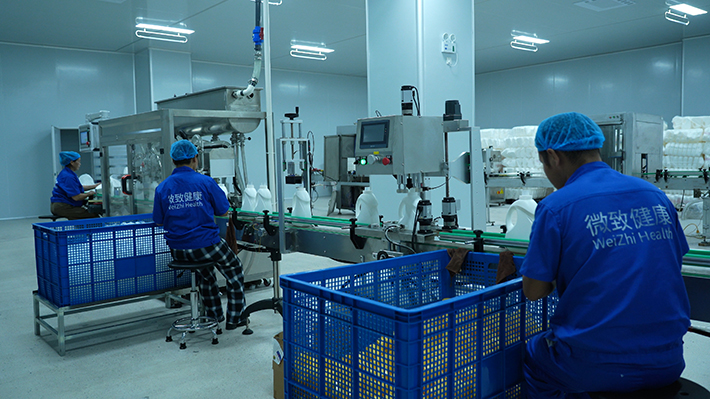
Local residents work at a health products company in Congjiang County, Guizhou Province (SHI DI)
| About Us | Contact Us | Advertise with Us | Subscribe |
| Copyright Beijing Review All rights reserved 京ICP备08005356号-5 京公网安备110102005860号 |


