| ChinAfrica |
| Ancient Practices, Modern Lives |
| Traditional Chinese medicine is entering global wellness routines as social media reshapes how tai chi, qigong and cupping are understood worldwide |
| By Miya Bendaoud | VOL. 18 July 2026 ·2026-07-01 |
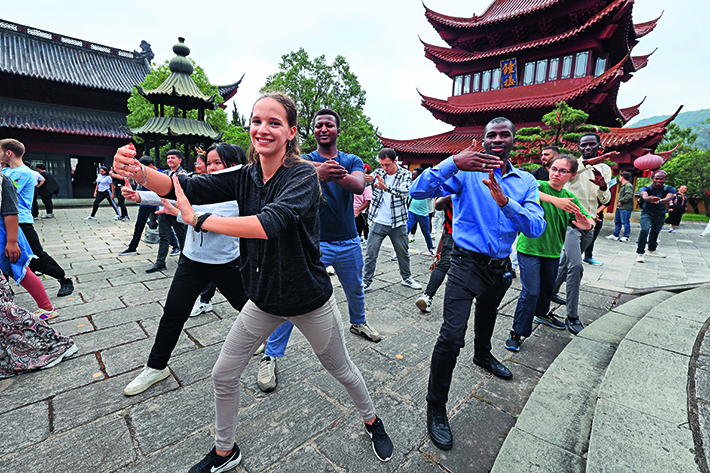
Foreign students practice tai chi in the Shuanglong tourist area of Jinhua, Zhejiang Province, on 26 September 2024 (VCG)
Traditional Chinese medicine is quietly becoming a kind of universal language. Tai chi, qigong and cupping, practices refined over millennia, are now moving far beyond China’s borders and slipping into contemporary wellness routines worldwide, carried by a generation that adopts, adapts and circulates them at scale.
Three minutes on TikTok or Instagram are often enough to encounter a gua sha routine, a sequence of qigong movements or a cupping session. What appears on screen is more than a demonstration. It hints at a shifting relationship with the body, with time and with care, shaped through repetition that is unremarkable yet persistent, gradually embedding itself into everyday habits.
These practices have drifted far from their original setting in China. They circulate, shift and reassemble in new contexts, often detached from the cultural frameworks in which they first emerged. Once transmitted through specialists and institutions, they now spread through fragmented, user-driven content online.
The phenomenon is especially visible in Western societies, where content creators and public figures act as accelerators. Gua sha, for instance, has become a staple in many skincare routines, often framed as a gentler, more “natural” alternative. “I will keep using gua sha in the morning. It is an excellent way to start my day, and I really love how relaxing it is,” said Renee Rodriguez, an American journalist for POPSUGAR, after trying a routine popularised by Kendall Jenner.
Cupping, meanwhile, is now routinely visible on elite athletes, most notably LeBron James, whose images marked with circular bruises have helped to push the practice into the mainstream.
Behind these images, a quieter shift is under way: an emphasis on rhythm, prevention and attentiveness to bodily sensation. “By slowing down, you gain time, energy, focus and clarity,” said Lee Holden, a qigong instructor and author of Ready, Set, Slow. In cultures defined by speed and saturation, such practices introduce a different tempo: slower, more intentional and increasingly countercultural.
Within this broader approach to well-being, simple gestures also carry weight. Drinking warm water throughout the day, for example, is a common habit in China, valued for its perceived benefits to digestion and circulation. It reflects a preventive logic rather than a corrective one. Where some cultures prioritise quick fixes, the Chinese approach tends to favour small, consistent routines that support long-term balance.
Beyond virality
Traditional Chinese medicine, developed over centuries, is based on concepts such as yin and yang, the circulation of qi and a holistic view of the body. It encompasses disciplines ranging from acupuncture to tuina massage, as well as pharmacopoeia and energy exercises.
In some contexts, these approaches are no longer seen as alternatives to conventional medicine but as complements. “Qigong is a time-tested moving meditation practice that helps you turn inward, cultivating peace, equanimity, centredness and balance, where the body is relaxed and the mind is at peace,” said Holden.
Traditional Chinese medicine’s holistic approach is attracting a growing number of international students. Some come from medical or paramedical backgrounds, others from personal interest, all seeking to broaden their understanding of care. “My mornings are part ritual, part science,” said Pietro Simone, an Italian-American facialist based in New York and London, who integrates gua sha and scientific supplements into his daily routine.
In China, specialised institutions now welcome a more diverse international intake. For many, the appeal lies not only in technique but in a different way of thinking about the body, health and prevention. Learning becomes experience, and sometimes a shift in perspective.
At Mount Wudang, a renowned centre of Chinese martial arts, foreign practitioners train daily in schools dedicated to kung fu. Often arriving with no prior knowledge of language or culture, they gradually enter a learning process that extends beyond the physical to include the underlying principles of these disciplines.
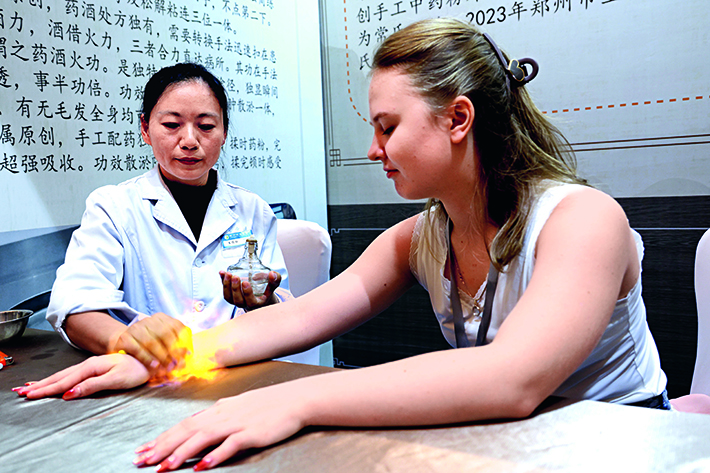
A visitor experiences alcohol-fire therapy during an exchange event in Zhengzhou, Henan Province, on 2 November 2025 (CNS)
From screen to practice
Social media remains a decisive entry point. It brings visibility to practices that would otherwise remain niche or require formal training. Content no longer simply shows; it explains, simplifies and makes these practices accessible.
Some creators have played a significant role in this circulation. Sherry Zhu, a Chinese influencer based in the US, has reached an international audience with her videos. In one she declared: “Tomorrow, you will be a little bit Chinese… no point resisting.” It is a line that is part irony, part observation, and captures the incremental adoption of these practices.
“These little daily habits are different, and that is precisely what sparks curiosity,” she added.
Short-form video is central to this dynamic. It is no longer just about watching but about trying, reproducing, adjusting and integrating. “I thought it was a trend… then I started taking it more seriously” appears frequently in user comments. A practice shifts from curiosity to habit.
In some cases, this translation becomes clinical. In China, foreign patients increasingly consult practitioners for persistent conditions. A French couple, for instance, turned to a specialist in Guangzhou after years of symptoms unrelieved by conventional treatments. Following assessment, a protocol combining acupuncture, moxibustion and cupping was prescribed, with gradual improvement reported over successive sessions. The approach rests on a holistic view of the patient, in which techniques are combined according to a logic of balance.
A culture in motion
What is at stake goes beyond virality. The modes of transmission themselves are changing. Practices no longer circulate solely through vertical institutional channels but through image, gesture and repetition.
A single video can be enough to show, suggest and initiate. Entry into these worlds no longer requires an academic framework but unfolds through direct, often intuitive experience. People observe, try and adjust. In this ecosystem, creators become transmitters. They translate, simplify and make ancient practices accessible to new audiences, without always conveying their full complexity.
What emerges is not simple cultural transfer but a more diffuse circulation. Social media initiates the movement, training programmes extend it, and between the two a lasting curiosity takes shape.
China, in the end, is no longer only described from a distance. It is practised, gesture by gesture. In this quiet rhythm, cultures move beyond observation and begin, slowly, to enter into dialogue.
| About Us | Contact Us | Advertise with Us | Subscribe |
| Copyright Beijing Review All rights reserved 京ICP备08005356号-5 京公网安备110102005860号 |


