| ChinAfrica |
| Restoring the Land, Renewing the Future |
| Through shared innovation, technology transfer and ecological restoration, China and Africa are building new solutions to combat land degradation and strengthen climate resilience |
| By Ehizuelen Michael Mitchell Omoruyi | VOL. 18 September 2026 ·2026-09-02 |
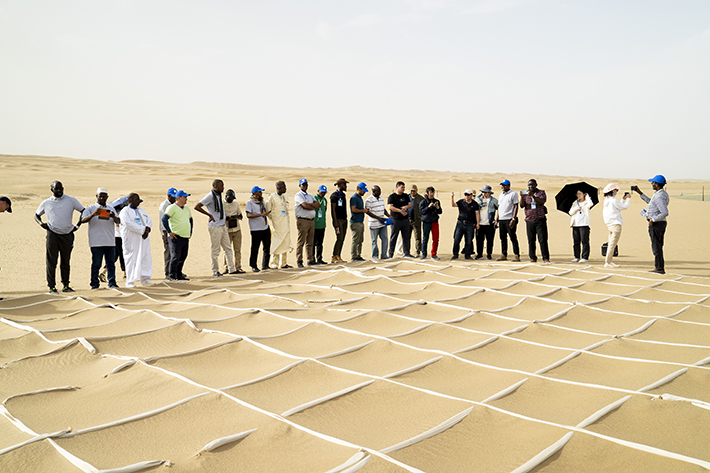
Participants attending a desertification control training workshop learn about sand-fixing technologies at a sand prevention demonstration area in Taklamakan Desert, Xinjiang Uygur Autonomous Region, China, on 12 June 2023 (XINHUA)
The world’s greatest climate challenge may not begin with rising seas or melting glaciers. It may begin with the slow movement of sand. Across Africa, billions of grains are steadily advancing across farmland, reducing harvests, threatening livelihoods and eroding decades of development gains. Desertification is no longer merely an environmental concern; it has become one of the defining economic and development challenges of the 21st century.
Amid this growing crisis, China and Africa are demonstrating that restoring degraded land is not simply about halting the advance of deserts. It is about enhancing food security, strengthening climate resilience and promoting shared modernisation across the Global South. The challenge has moved beyond the remit of environmental authorities alone. It is now central to agricultural strategies, economic planning, climate governance and international development cooperation.
The United Nations Convention to Combat Desertification (UNCCD) estimates that 40 percent of the world’s land is degraded, affecting 3.2 billion people and undermining productivity and resilience. Africa bears a disproportionate share of this burden. Nearly two-thirds of the continent is covered by drylands, while the Sahara continues to expand southward into the Sahel, placing agricultural systems and rural livelihoods under growing pressure.
The African Development Bank warns that climate change could reduce agricultural productivity in parts of Africa by up to 30 percent by 2050 without stronger adaptation measures. Meanwhile, the World Bank estimates that climate-related impacts could force more than 86 million people across Sub-Saharan Africa to migrate internally by mid-century. Land restoration is therefore not only an environmental necessity, but also a fundamental development priority.
These pressures explain why combating desertification has become a strategic pillar of China-Africa cooperation. As both sides pursue greener pathways to modernisation, ecological restoration has emerged as an area where experience, innovation and policy coordination converge. Rather than focusing solely on financial support, this partnership increasingly integrates infrastructure development, technology transfer, scientific research, capacity building and policy dialogue. The emphasis is shifting from responding to crises towards building long-term resilience and shared prosperity.
Turning challenges into opportunities
China’s experience offers valuable lessons. Several decades ago, north China faced expanding deserts, frequent dust storms and declining agricultural productivity. Through long-term national planning, initiatives such as the Three-North Shelterbelt Forest Programme and the Beijing-Tianjin Sandstorm Source Control Project have integrated engineering solutions, scientific research, digital monitoring, and community participation through afforestation campaigns, watershed management and ecological compensation measures.
According to China’s National Forestry and Grassland Administration, the overall trend of desertification has been reversed, while the UNCCD recognises China’s achievements as a leading example of large-scale land restoration. The experience demonstrates that successful ecological restoration depends not only on investment, but also on strong institutions, technological innovation, policy continuity and sustained political commitment.
African countries are adapting these experiences to their own ecological realities rather than simply replicating China’s model. This approach aligns with the African Union’s Agenda 2063, the Great Green Wall Initiative, the Sustainable Development Goals and China’s Global Development Initiative. Together, these frameworks recognise that restoring degraded ecosystems is essential for inclusive growth and climate resilience. China-Africa collaboration is therefore moving beyond one-way knowledge transfer towards joint innovation and locally appropriate solutions.
Institutional collaboration continues to deepen through the Forum on China-Africa Cooperation (FOCAC), the Belt and Road Initiative’s Green Development Agenda and cooperation with the UNCCD, the Food and Agriculture Organisation (FAO) of the United Nations and the United Nations Environment Programme. Partnerships among universities, research institutes, forestry agencies, and agricultural technology centres are expanding research, technical assistance and environmental governance. This broader framework is moving shared efforts beyond isolated projects towards long-term capacity building and coordinated policy action.
Technology transfer and human capital remain central. Chinese expertise in water-saving irrigation, drought-resistant crops, precision agriculture, satellite monitoring, remote sensing, artificial intelligence and digital land management is strengthening Africa’s environmental planning and climate resilience. Through FOCAC mechanisms, African officials and specialists have received training in sustainable land management, forestry, water conservation, and ecological engineering. The 2024 Beijing Summit of FOCAC further reinforced this momentum through the Beijing Action Plan (2025-2027), aligning with UNCCD COP16 to prioritise green development, biodiversity conservation, climate adaptation and desertification control, demonstrating that restoring land is fundamental to protecting livelihoods, strengthening food systems and advancing shared modernisation across the Global South.
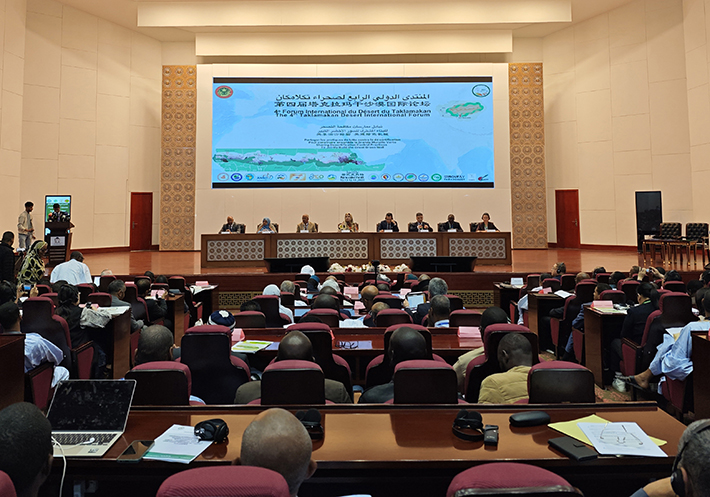
Officials and experts from China and Africa attend the fourth Taklamakan Desert International Forum in Nouakchott, Mauritania, on 14 December 2025 (XINHUA)
Finding joint solutions
As China-Africa collaboration expands, its significance extends far beyond the restoration of degraded land. At its core, the relationship addresses one of Africa’s greatest barriers to sustainable development while reinforcing China’s commitment to green modernisation and South-South cooperation. As climate change intensifies across the developing world, restoring ecosystems is becoming essential not only for environmental protection, but also for food security, economic transformation and long-term stability. Environmental restoration is increasingly recognised as an investment in economic resilience, social stability and sustainable prosperity rather than merely an ecological objective.
For Africa, the stakes are particularly high. Agriculture employs more than half of the continent’s workforce and remains the primary source of income for hundreds of millions of people. Yet rising temperatures, erratic rainfall, prolonged droughts and declining soil fertility are undermining agricultural productivity and rural livelihoods.
Desertification therefore threatens not only food production, but also employment, fiscal stability, industrialisation and poverty reduction. By supporting sustainable land management, climate-smart agriculture, modern irrigation and ecological restoration, China-Africa collaboration is strengthening Africa’s productive capacity while helping the continent transition from climate vulnerability to climate resilience.
Food security further underscores the importance of this relationship. According to the FAO, more than one-fifth of Africa’s population continues to experience undernourishment, while rapid population growth and urbanisation are placing even greater pressure on food systems. Restoring degraded land is therefore not simply an environmental objective, but an economic investment capable of improving agricultural productivity, conserving water, protecting biodiversity and strengthening rural livelihoods. The World Bank argues that investments in land restoration generate substantial long-term returns by reducing disaster risks, improving ecosystem services and enhancing resilience.
China’s experience in integrating ecological restoration with agricultural modernisation offers practical lessons that complement Africa’s own strategies. Healthy ecosystems are productive economic assets, supporting agriculture, rural employment, water security, tourism and climate-resilient infrastructure. Investing in ecological restoration is therefore not merely an environmental policy measure, but a long-term development strategy capable of generating inclusive economic growth.
Building a resilient future
The relationship is equally important for China. Green development has become a central pillar of China’s engagement with Africa through FOCAC, the Global Development Initiative and the Belt and Road Initiative’s Green Development Agenda. Supporting African countries in combating desertification reinforces China’s commitment to implementing the UN 2030 Agenda for Sustainable Development, the Paris Agreement and the Kunming-Montreal Global Biodiversity Framework, while demonstrating the value of South-South cooperation based on common development goals.
Technology and innovation will determine the long-term impact of these shared efforts. Advances in satellite monitoring, artificial intelligence, geographic information systems, precision irrigation, digital mapping and climate modelling are transforming ecosystem management. Joint research among Chinese and African universities, research institutes and technology companies can accelerate locally adapted solutions. Continued investment in education, technical training and institutional development will enable African countries to independently manage increasingly sophisticated environmental technologies.
Looking ahead, China-Africa collaboration should deepen research, strengthen digital environmental governance, expand green finance and place local communities at the centre of implementation to ensure restoration projects generate employment, strengthen rural livelihoods and build lasting institutional capacity.
The author is Executive Director of Centre for Nigeria Studies, Institute of African Studies, Zhejiang Normal University
| About Us | Contact Us | Advertise with Us | Subscribe |
| Copyright Beijing Review All rights reserved 京ICP备08005356号-5 京公网安备110102005860号 |


