| ChinAfrica |
| The Sun Revives the Desert |
| How China is using solar power to combat desertification |
| By GE LIJUN | VOL. 18 October 2026 ·2026-09-21 |
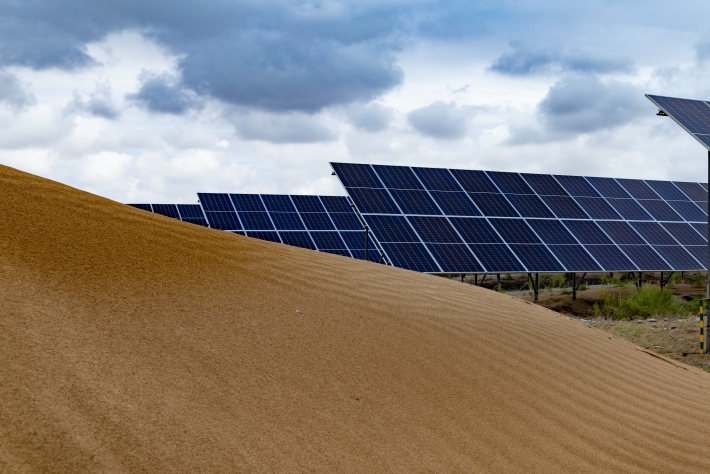
A dune near a solar power station in Jiuduntan in Wuwei, Gansu Province, on 9 September (CHEN JIAN)
The desert was unfamiliar territory for Liu Ziyue when she joined POWERCHINA Beijing Engineering Corp. (BJEC) as a new recruit. A recent graduate, the 27-year-old researcher soon joined a research project on combating desertification at three solar power stations in Wuwei, Gansu Province, where she was tasked with exploring new ways to restore fragile ecosystems.
Her work focuses on developing fly ash-based products to stabilise sand and restore vegetation, then testing them in the harsh conditions of the desert.
But challenges emerged quickly. The slabs began to break and the seeds failed to germinate, forcing Liu to spend two weeks adjusting her protocol in response to what she observed in the field.
“It is only by going out into the field that you can uncover the real problems that don’t arise in the laboratory,” she told ChinAfrica.
Liu’s experience is part of a broader research effort to develop key technologies for combating desertification and restoring ecosystems around large-scale renewable energy hubs in desert, arid areas and Gobi regions. China has been expanding such hubs in areas including Gansu, Inner Mongolia and Xinjiang, where vast expanses of land offer exceptional potential for solar and wind power. Yet, the same harsh environments present formidable challenges: sandstorms can threaten facilities, while fragile ecosystems require careful protection.
BJEC was entrusted with leading the research programme in 2024. Its team selected three power stations in Wuwei - Jiuduntan, Longyu and Minqin - as testing grounds, where laboratory findings are being put to the test under real-world conditions. Around 20 BJEC staff members are involved, 70 percent of them young researchers and engineers.
Built on the edge of the Tengger Desert, the three power stations are becoming laboratories in their own right, where energy production is being combined with environmental restoration. The approach brings together electricity generation, intercropping and vegetation growth beneath photovoltaic modules, with the long-term goal of transforming these arid landscapes into a form of ecological protection areas.
Battle against desertification
Ma Shijun, chief design engineer of the research project and a native of Tianshui, Gansu Province, admitted that he only truly grasped the reality of the desert after joining the project. The three experimental sites have distinct characteristics, including shifting dunes, saline soils and gravel deserts, providing an ideal setting for tailoring interventions to each environment.
The strategy is based on two complementary lines of defence. On the periphery, a network of metal nets, high-density polyethylene (HDPE) nets, sand-fixation grid nets and plant-fibre nets slows the wind and traps incoming sand. In Longyu, this barrier stops around 50 to 60 percent of the sand deposits. By the time the entire filtering network has been traversed, less than 10 percent of the particles reach the centre of the complex.
The second line of defence acts directly to stabilise the sand. Between the rows of structures, HDPE nets arranged in a grid pattern reduce wind speed at ground level, while beneath the panels, a plant-fibre-based stabiliser consolidates the surface layer. In Minqin, researchers are also testing a gravel mulch beneath the modules to protect equipment from sand abrasion.
The team is also evaluating alternatives to traditional straw squares, whose effectiveness diminishes after three to five years. It is experimenting with structures made from plant fibres, polylactic acid (PLA) and HDPE as well as innovative materials formulated from fly ash. The plant-fibre nets are biodegradable and highly weather-resistant, while the PLA and HDPE nets have a lifespan of more than 10 years and remain easy to install.

Ma Shijun, chief design engineer of BJEC, demonstrates the perimeter protection at a solar power station in Longyu in Wuwei, Gansu Province, on 8 September (GE LIJUN)
Balancing energy and ecology
Once the substrate has been stabilised, the revegetation phase begins. At Jiuduntan, 10 to 15 plant species suited to arid conditions, mainly native shrubs and grasses, have been introduced. Their survival rate, growth rate and optimal planting density are closely monitored, both beneath the modules and between the rows. To preserve the local ecosystem without resorting to chemical rodenticides, small wire-mesh cages are used to protect young shoots from rodents.
Water, a precious resource in a desert environment, is managed as efficiently as possible. The team is developing a system to collect rainwater running off the photovoltaic panels. The water is stored underground during the wet season before being redistributed in spring. While the mechanical anchoring structures provide an immediate result, it is root development that ensures the soil is held in place over the long term.
While energy efficiency once took precedence over environmental requirements, the authorities now require both to be developed in tandem. In June, the National Forestry and Grassland Administration issued two standards governing the development of photovoltaic installations in desert areas and their ecological monitoring. From then on, restoration measures must be designed, implemented and put into operation alongside the solar infrastructure. In anticipation of this, the team has already adopted the Shannon Index, species richness and evenness to measure plant biodiversity, in anticipation of future regulatory requirements.
“Electricity generation falls within the remit of the energy sector, while combating desertification falls within that of forests and grasslands. We wish to promote their integration, in order to guarantee revenue from electricity generation while improving ecological outcomes,” Ma told ChinAfrica.
This synergy also extends to the pursuit of sustainable economic benefits. To offset the additional costs associated with restoration, the project developer China Huadian (CHD) is exploring various agro-ecological opportunities. In Minqin and Jiuduntan, trials are being conducted on high-value-added species, such as wild desert onion, which thrives particularly well in the shade of the solar panels. In Longyu, research is focusing on profitable crops such as black goji berries.
The initial results are promising. In some areas formerly dominated by shifting dunes, vegetation cover has risen from less than 5 percent to more than 70 percent. The panels reduce wind speed by 30 to 50 percent and, combined with physical barriers, accelerate soil stabilisation. Regular sightings of gazelles, hares and foxes also indicate a return of wildlife.
However, these positive results need to be validated over time. The trials, which began on 15 November 2024, will run until 2027. Automated measuring equipment continuously records wind speed, sand movement, plant growth, precipitation and soil moisture levels. The team then intends to consolidate its findings on an 800-mu (53-hectare) demonstration plot in Gansu.
Towards industry standards
The ultimate aim is to develop bespoke solutions and eventually elevate them to the status of standards. The project uses a modular approach comprising around 20 techniques that can be combined according to the specific constraints of each site. These advances will first enable CHD to establish an internal set of standards, which could then contribute to the development of sectoral and national standards. Ultimately, these methodologies could be rolled out in other regions with similar characteristics, such as the Hexi Corridor and west Inner Mongolia.
In 2025, China accelerated the green and low-carbon transition of key sectors. The first phase of deploying large-scale new energy facilities in deserts, arid areas and Gobi regions is now largely complete, with the facilities operational. The current research programme, meanwhile, focuses on the second wave of power stations awarded to CHD.
“While contributing to the national energy supply and to China’s targets for carbon peaking and carbon neutrality by 2030 and 2060 respectively, central state-owned enterprises also bear the responsibility of leading by example in ecological restoration,” Ma said.
For Liu and her team, each on-site trial enables them to refine their processes and deepen the synergies between energy production and environmental conservation. Ultimately, their work is expected to establish the photovoltaic sector as a genuine driving force behind the regeneration of desert areas.
| About Us | Contact Us | Advertise with Us | Subscribe |
| Copyright Beijing Review All rights reserved 京ICP备08005356号-5 京公网安备110102005860号 |


