| ChinAfrica |
| The Legacy of the Long March |
| Tracing the historic route offers a glimpse into the sacrifice, resilience and determination behind China’s rise |
| By Bernard Momanyi | VOL. 18 October 2026 ·2026-10-08 |

A scene from the performance The First Crossing of the Long March in Yudu, Jiangxi Province, on 29 July (XINHUA)
Standing atop the rugged slopes of Loushan Pass in southwest China, it is difficult to imagine the hardships faced by Red Army soldiers who crossed these mountains more than 90 years ago.
The steep valleys, winding roads and imposing peaks of Guizhou Province, however, offer a glimpse of the daunting journey of the Long March, one of the defining events in modern Chinese history.
In July, I was part of an international delegation attending a seminar on media cooperation in China. Together, we traced key sites associated with the country’s revolutionary struggle and the Long March.
The visit coincided with the 105th anniversary of the founding of the Communist Party of China (CPC), offering an opportunity to explore how a journey that began in the 1930s continues to influence how China understands its development path today.
Tracing a historic journey
Our first stop was Yeping in Ganzhou, Jiangxi Province, regarded as one of the birthplaces of the Chinese revolution. Preserved revolutionary buildings and historical relics offer visitors an insight into the early years of the Communist movement and the sacrifices made during a period of war and political upheaval.
Nearby stands the famous Red Well, a symbol of the Party’s emphasis on serving the people. Local guides recount how villagers struggled to access clean water until Chairman Mao led efforts to construct the well, an episode that remains embedded in local memory.
The story of the Long March became more vivid in Yudu County. It was here, in October 1934, that the Central Red Army began its historic journey after gathering along the banks of the Yudu River. Facing encirclement and overwhelming military pressure, thousands of soldiers embarked on a trek across some of China’s most difficult terrain. Today, the Memorial Garden for the Long March Starting Point of the Central Red Army commemorates that departure.
At the Long March Grand Theatre in Yudu, we watched The First Crossing of the Long March, a stage production that combines music, storytelling and visual effects to recreate the early stages of the historic journey. The performance brought the events to life in a way that complemented the historical sites we had visited, turning a distant chapter of history into an experience that could be felt as well as understood.
From Jiangxi, we travelled to Guizhou, where several pivotal moments unfolded. At the Zunyi Conference Site, we learned about the meeting held in January 1935 that helped redefine military strategy and is widely regarded as a turning point in the revolution. We also visited Loushan Pass and the Gouba Conference Site, where important decisions were made amid uncertainty and immense challenges.
Tracing sections of the route through Guizhou’s mountains and valleys was among the most memorable parts of the journey.
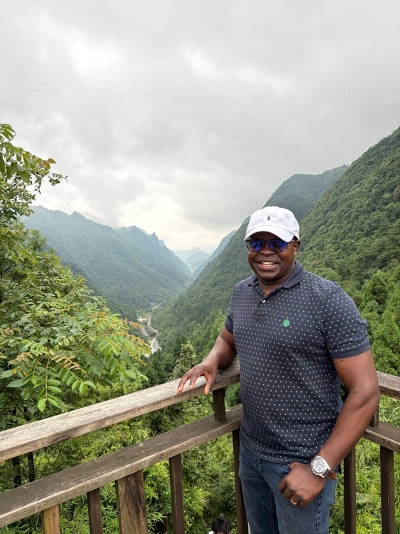
Bernard Momanyi during a visit to Loushan Pass Scenic Area in Zunyi, Guizhou Province, on 5 July (COURTESY)
A living memory
Walking through these sites, one quickly understands why the Long March occupies such a prominent place in China’s national consciousness. For the CPC, it represents perseverance, sacrifice and commitment to long-term goals despite enormous obstacles.
At the memorial garden in Yudu, 78-year-old former factory worker Liu Jianhua had travelled with his grandchildren to learn more about the historic journey.
“I wanted them to see where part of our history happened,” he said. “Many young people today have grown up with good roads, good schools and opportunities. They should understand that these achievements did not come easily.”
At the Zunyi Conference Site, 86-year-old retired teacher Zhang Guoqiang recalled hearing stories about the Red Army from his parents.
“The Long March was not just about soldiers marching. It was about believing in a better future when China was poor and weak,” he said.
Younger visitors also see relevance in the story. Chen Xia, a 26-year-old university graduate visiting Zunyi, said the Long March teaches her generation “perseverance, responsibility and the importance of working towards long-term goals.”
The story resonated with members of the international delegation as well. Adeng Mayik, press secretary in the Office of the Secretary-General of the Sudan People’s Liberation Movement and a news anchor with the South Sudan Broadcasting Corporation, connected the Long March with South Sudan’s history of struggle and liberation.
“It is very relevant to us because of the liberation struggle and the long civil war we have had in our country before gaining independence,” she said.
Paul Ilado, editorial director at Radio Africa Group in Kenya, similarly connected the experience with Kenya’s struggle for independence and the Mau Mau uprising.
“Walking the Red Army’s Long March route stirs echoes of Kenya’s Mau Mau struggle. Our fighters too endured hunger, harsh terrain and superior colonial firepower,” he said. “Both movements fought for land and dignity against brutal oppression.”
What struck him most was how China has preserved and institutionalised its revolutionary history.
“China has etched every detail into national memory. Museums, school textbooks and immersive tours ensure no generation forgets,” he said.
Ilado said the experience offered Kenya a lesson in preserving historical memory and passing it on to future generations.
From neighbouring Mongolia, Nomuunaa Sumiyadorj, political officer at the People’s Party Foreign Relations Department and International Politics Editor of Mongoliin Ünen, also reflected on China’s preservation of its revolutionary heritage.
“It’s impressive to see how China has preserved its history for generations,” she said. “That heritage continues to inspire people to greatness.”
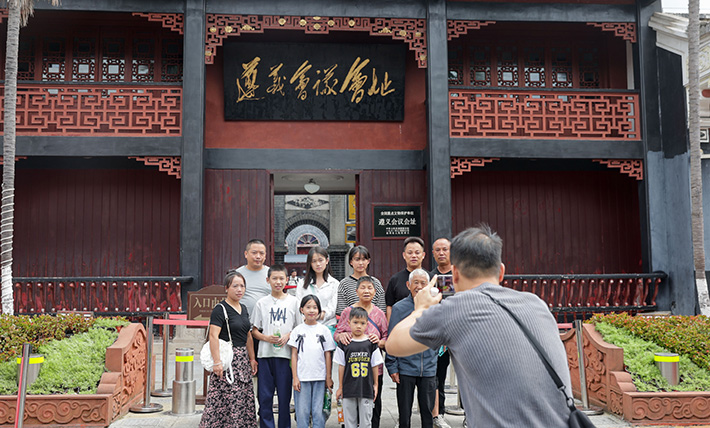
Tourists pose for a group photo at the Zunyi Conference Site in Zunyi, Guizhou Province, on 8 October 2025 (XINHUA)
Road to modern China
The journey through Jiangxi and Guizhou also offered an opportunity to see how the Long March is connected, in the Chinese narrative, with the country’s modern development.
During a reception for visiting journalists in Guizhou, Lu Yongzhen, a member of the Standing Committee of the CPC Guizhou Provincial Committee, drew a direct connection between the revolutionary journey and China’s transformation.
“Today, we have constructed many roads and bridges that connect communities which were once difficult to access. The spirit of the Long March lives on,” he said.
His remarks resonated throughout our journey across Guizhou, where expressways carve through mountains, high-speed rail links connect distant cities and bridges span valleys that once posed formidable barriers to travel.
Across China, similar changes have taken place over the past several decades. The country has undergone a profound economic transformation, with hundreds of millions of people lifted out of poverty and major investments in infrastructure, education, technology and manufacturing.
Chinese officials often draw a line between these achievements and the determination embodied by the Long March. As our delegation followed the route, one theme emerged repeatedly: China’s transformation did not happen overnight.
The roads, bridges, high-speed railways and modern cities that define China today are, in the eyes of many Chinese, part of a much longer journey that began with the sacrifices of the Red Army nearly a century ago.
Ninety years later, the Long March may be over, but the spirit associated with it continues to shape how many Chinese understand the country’s past, present and future.
The author is editorial director of Capital FM, Kenya
|
||||||||
| About Us | Contact Us | Advertise with Us | Subscribe |
| Copyright Beijing Review All rights reserved 京ICP备08005356号-5 京公网安备110102005860号 |


