| ChinAfrica |
| Sole Operator |
| Automation is powering the rise of one-person companies in China’s digital economy |
| By GE LIJUN | VOL. 18 May 2026 ·2026-05-08 |

OPCs are experiencing rapid growth in the AI era (VCG)
In northwest Beijing, the Zhongguancun AI North Latitude Hub offers a glimpse into the future of entrepreneurship. There are no crowded meeting rooms or long rows of office cubicles. Instead, a single high-performance computer, running several AI tools at once, is enough to power a startup. It is a quiet but striking scene that reflects a broader shift in China’s business landscape: the rise of one-person companies (OPCs), ventures built and run by a single individual.
In this OPC community, Su Kui, the founder and only employee of Beijing Nezha Interactive Entertainment Technology, is one such individual. In under a year, his “AI + animation” creation tool has drawn more than 6,000 registered users worldwide. He believes that with AI, a single person can match the productivity of a much larger team, while benefitting from quicker decision-making and the freedom to adapt strategy with ease.
OPCs refer to entrepreneurs who, with the help of AI, are capable of handling the entire business cycle from product design to market launch, on their own. While the company is not always composed of a single person in the strict sense, it generally revolves around a central figure, supported by intelligent agents, a few occasional collaborators, and outsourced services.
This trend is part of a broader policy direction. This year’s Government Work Report, presented during the Two Sessions held in March in Beijing, mentions for the first time the need to “create new forms of smart economy.” OPCs are a prime example of this. They are rapidly becoming a new avenue for innovation and entrepreneurship, attracting an increasing number of creators, while various local governments are introducing support policies to build a position in this emerging niche.
Individual as an enterprise
Supported by increasingly powerful AI tools, most notably OpenClaw, a growing number of entrepreneurs are adopting the OPC model. According to Hu Yanping, a visiting professor at the Shanghai University of Finance and Economics, OPCs have evolved from a mere concept into a full-fledged phenomenon because today’s AI technology allows an individual to manage an entire business cycle independently.
OPCs span numerous fields: AI agent development, business services, AIGC content creation, education, biopharmaceuticals, e-border commerce and livestreaming.
Fei Hongfei, founder of Beiyoo AI Tech, launched his company in 2025. Drawing on extensive experience in the digital transformation of government agencies and businesses, the 43-year-old entrepreneur established his own venture, offering AI consulting, solution design and the implementation of intelligent agents for both public and private sector clients.
In his day-to-day operations, Fei focuses on strategic decisions, client relations and final project approvals. Routine tasks, such as document sorting, drafting initial versions, archiving information, coding support and testing, are largely handled by AI and automated workflows.
This smart division of labour has allowed him to build a highly efficient production system. Recently, he helped a Shenzhen-based startup specialising in smart toys to implement a lightweight yet fully operational system of intelligent agents, combining workflow platforms, large AI models and collaborative tools.
Even with such productivity gains, OPCs face real challenges: limited capital, scarce resources and a lack of entrepreneurial experience. Many founders are recent graduates or former employees of large tech firms, taking their first steps into the world of startups.
To address these needs, OPC-focused communities have emerged, offering tailored services, trade shows, project presentations and trusted spaces where entrepreneurs can collaborate.
Consider Zhao Ruolan. A former algorithm engineer at a brain-computer interface company, she joined the Honghuhui OPC community in Hangzhou in 2025. There, she launched her own company and a personal development app.
Since its inception, over 1,300 projects have applied to the community, with about 30 selected, according to Wang Jiahao, a partner at Honghuhui. For Zhao, the community transformed what could have been a lonely venture into a supportive ecosystem built on collaboration and shared knowledge.
The Zhongguancun AI North Latitude Hub offers a similar environment. Its 800-square-metre shared space features relaxation areas, cafeterias and administrative offices. Entrepreneurs gain help with business registration, tax management and public policy applications, while also connecting with investors and industry experts. It was in this vibrant setting that Su Kui formed his first professional partnerships.
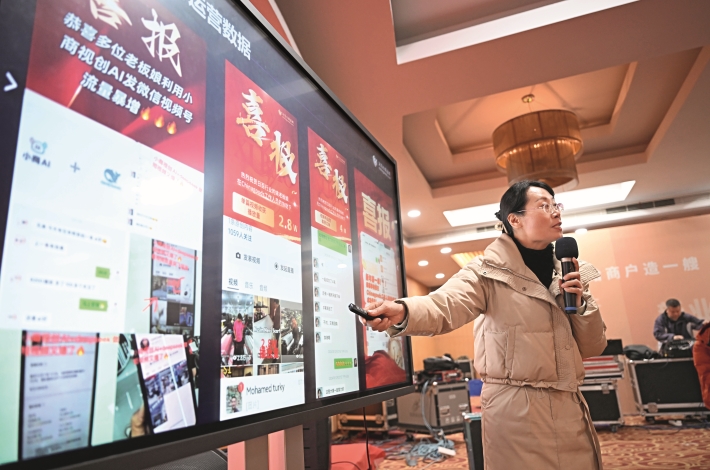
A training session on AI-powered product marketing is held at the Yiwu International Trade Market in Zhejiang Province, attracting hundreds of merchants, on 6 March 2025 (CNS)
A favourable political climate
Local governments are responding enthusiastically to this emerging form of entrepreneurship. Cities such as Beijing, Hangzhou, Suzhou and Shenzhen have introduced specific plans to attract AI talent and establish entrepreneurship parks dedicated to AI start-ups. According to China Newsweek, at least 17 cities or local governments nationwide have already announced development initiatives to support AI ventures.
Support measures go beyond simple rent reductions or financial aid. Some local governments directly provide AI agent tools and simplified access to computing power, without the usual administrative red tape.
In Beijing’s Yizhuang Economic and Technological Development Zone, the approach is even more hands-on. Public contracts are made available to start-ups, giving them real-world business opportunities. “Each year, the community receives at least 100 contracts covering content generation, visual design and franchise promotion,” an official from the Yizhuang Moshu AI startup community told Securities Daily.
Thanks to these measures, many OPCs in the zone have reached profitability, despite operating with lean, small teams.
According to experts, OPCs are significantly lowering the barriers to entrepreneurship, accelerating innovation in specialised niches and driving improvements in public AI-related infrastructure, including computing power, data resources and evaluation systems.
Promoting OPC communities in cities like Beijing, Hangzhou and Shenzhen effectively lays the groundwork for entrepreneurial ecosystems built for the AI era.
But questions remain. Some entrepreneurs argue that grants or free workspace matter less than access to real-world projects and verifiable orders. Experts are calling for local policies to reflect regional industrial needs, encouraging the integration of AI agents into sectors such as manufacturing, logistics and e-commerce.
Human-machine collaboration also introduces new challenges, ranging from copyright and data protection to liability for automated errors.
“It is necessary to establish a light regulatory framework centred on the entrepreneur’s digital identity,” He Jing, an associate professor at Beihang University, told Ningbo Daily. Such a framework would cover intellectual property, data privacy and contractual obligations.
Despite these hurdles, many observers remain optimistic. OPCs, as a new form of AI-driven entrepreneurship, are injecting fresh energy into economic activity and enabling low-cost business creation, opening the doors to entrepreneurship for a broader swath of society in the age of AI.
|
||||||||||||
| About Us | Contact Us | Advertise with Us | Subscribe |
| Copyright Beijing Review All rights reserved 京ICP备08005356号-5 京公网安备110102005860号 |


